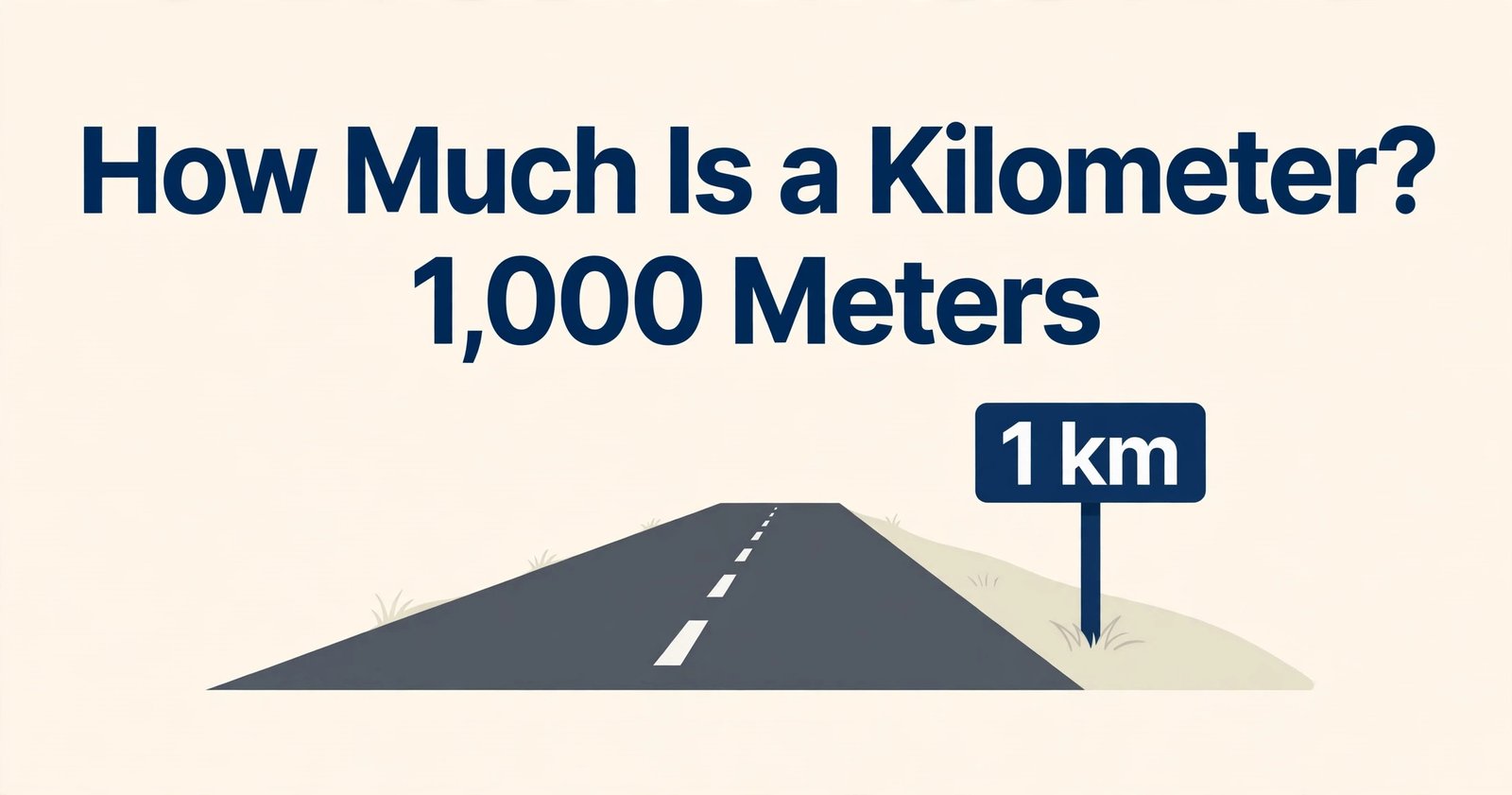
How much is a kilometer? A kilometer is 1,000 meters — that is 0.621371 miles, or about 62 percent of a mile. It is a distance you can walk in about 12 minutes at a normal pace, run in about 5 to 6 minutes if you are fit, and drive in about 1 minute at 60 kilometers per hour.
A kilometer is the everyday distance unit of most of the world. Road signs, running races, and maps outside the United States are all measured in kilometers, so knowing what a kilometer feels like is useful whether you are traveling, training for a 5K race, or reading a distance on a sign.
This guide explains exactly what a kilometer equals in meters, miles, feet, and yards, how long it takes to walk, run, cycle, and drive one, how many steps it takes, and how many calories it burns.
| Unit | Equivalent to 1 kilometer |
|---|---|
| Kilometers | 1 km |
| Meters | 1,000 m |
| Centimeters | 100,000 cm |
| Miles | 0.621371 mi |
| Feet | 3,280.84 ft |
| Yards | 1,093.61 yd |
Quick tip: Multiply kilometers by 0.621371 to get miles — 1 kilometer is 0.621371 miles.
What a Kilometer Equals
A kilometer is defined as exactly 1,000 meters, and the meter is the base unit of length in the metric system. The prefix “kilo” means one thousand, so the word kilometer literally means one thousand meters. That is the cleanest conversion in this guide: there is no rounding involved, because 1 kilometer is 1,000 meters by definition.
In smaller metric units, a kilometer is 100,000 centimeters. A meter is a little longer than a yard, about 3.28 feet, so a kilometer is a thousand of those meter-lengths laid end to end.
In imperial units, a kilometer is 0.621371 miles. That is the figure to remember if you live in the United States, where miles are the standard road unit. A kilometer is a little under two-thirds of a mile, so a mile is noticeably longer: one mile equals 1.60934 kilometers.
A kilometer is also 3,280.84 feet and 1,093.61 yards. To picture 3,280.84 feet, think of it as a little more than half a mile of walking, or about eleven American football fields laid end to end.
How Long Does It Take to Walk a Kilometer?

Walking a kilometer takes about 12 minutes at a normal, steady pace of 5 kilometers per hour. That is the pace most healthy adults settle into when they are walking somewhere with a purpose but not rushing: a relaxed stride, arms swinging, breathing easy. If you walk at a slower pace of about 4 kilometers per hour — a gentle stroll, or walking with a small child — the same kilometer takes about 15 minutes.
The maths behind those times is simple. At 5 kilometers per hour you cover 5 kilometers in 60 minutes, so one kilometer takes 60 divided by 5, which is 12 minutes. At 4 kilometers per hour the same calculation gives 60 divided by 4, which is 15 minutes.
In everyday terms, a 12-minute walk is the kind of walk most people do without noticing the time: from a car park to a shop, around a neighborhood a few times, or from one end of a large park to the other.
How Many Steps Are in a Kilometer?
A kilometer takes about 1,250 to 1,550 steps for most adults, and a commonly quoted figure is about 1,300 steps. The range exists because step length is different for everyone: taller people with longer legs take fewer, longer steps, while shorter people take more, shorter steps. Walking speed matters too, because a faster stride is usually a longer stride.
The calculation is straightforward. An average adult step is about 0.65 to 0.8 meters long, so dividing 1,000 meters by a step length in that range gives roughly 1,250 to 1,550 steps. A person with an average step of about 0.76 meters will take about 1,300 steps to cover a kilometer, which is why that figure shows up so often on fitness trackers and health websites.
This is also why the famous 10,000-steps-a-day goal works out to roughly 7 to 8 kilometers of walking.
How Long Does It Take to Run a Kilometer?

Running a kilometer takes about 5 to 6 minutes for a fit runner, and about 8 to 10 minutes for someone jogging at an easy, conversational pace. For most people the 5-to-6-minute range is a strong, realistic target, and 8 to 10 minutes is a comfortable jog that still counts as running.
The difference between running and jogging a kilometer is mostly about effort. A fit runner moving at 10 to 12 kilometers per hour covers a kilometer in 5 to 6 minutes, because 60 minutes divided by 10 is 6 minutes and 60 divided by 12 is 5 minutes. A jogger moving at about 6 to 7.5 kilometers per hour takes 8 to 10 minutes for the same distance.
A kilometer is also the natural building block of the 5K race, which is 5 kilometers long. If you can run one kilometer in about 6 minutes, you can finish a 5K in about 30 minutes — a popular goal for beginner runners.
How Long Does It Take to Cycle a Kilometer?

Cycling a kilometer takes about 3 to 4 minutes at a relaxed pace. A casual rider cruising at about 15 kilometers per hour covers a kilometer in 4 minutes, because 60 minutes divided by 15 is 4. A slightly quicker rider at about 20 kilometers per hour does it in 3 minutes. Fit road cyclists riding at 30 kilometers per hour or more can cover a kilometer in about 2 minutes.
Those times explain why a bicycle feels so much faster than walking. A kilometer that takes about 12 minutes on foot takes only about 3 to 4 minutes on a bike, even at a relaxed pace — roughly three to four times faster.
Hills, wind, and traffic lights all change the time, of course. A steep uphill kilometer can take a casual cyclist 6 minutes or more, while a gentle downhill stretch can take under 2 minutes.
How Long Does It Take to Drive a Kilometer?
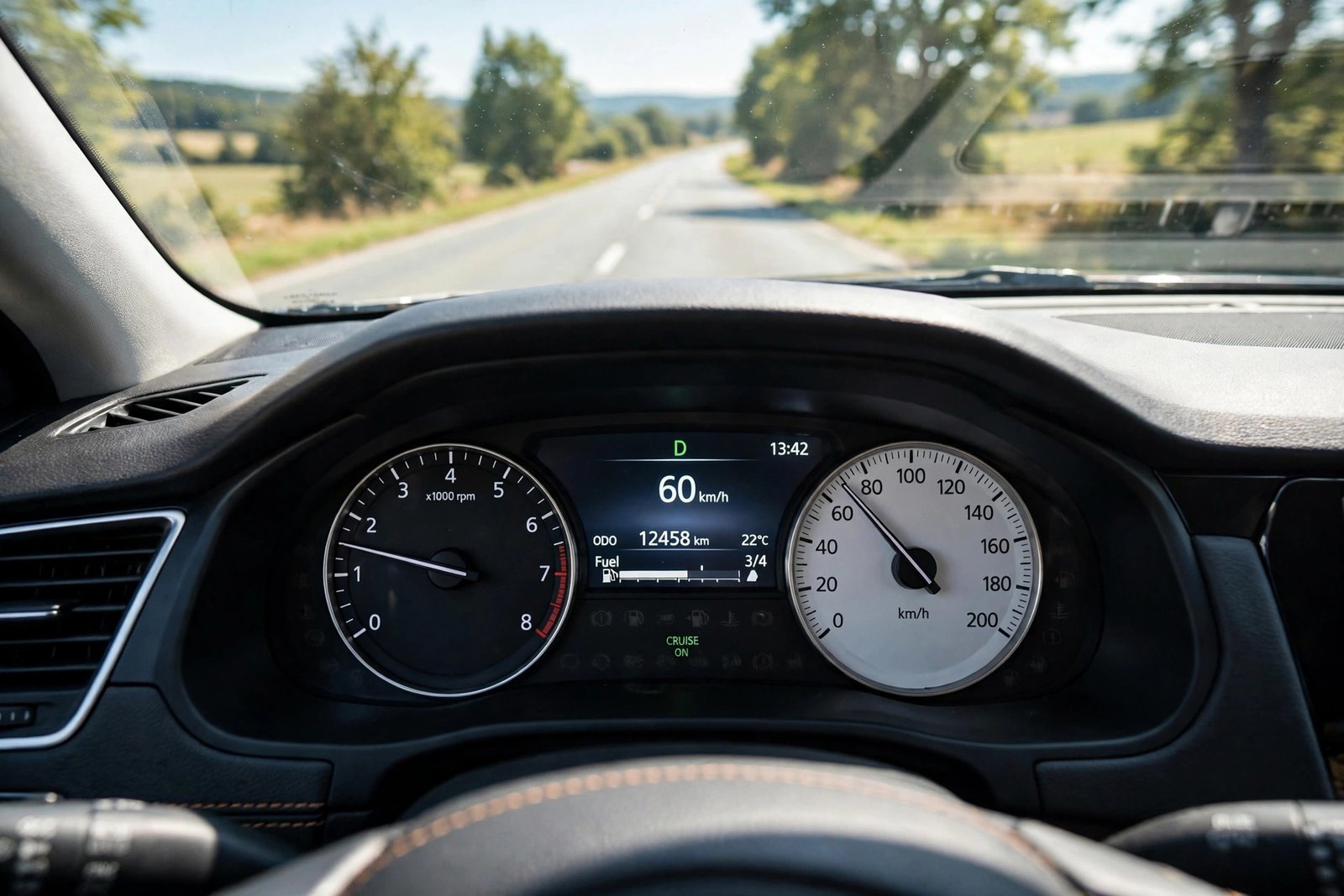
Driving a kilometer takes about 1 minute at 60 kilometers per hour, about 40 seconds at 90 kilometers per hour, and about 36 seconds at 100 kilometers per hour. The maths is the same simple division used for walking and cycling: at 60 kilometers per hour you cover 60 kilometers in 60 minutes, so one kilometer takes exactly 1 minute. At 90 kilometers per hour, 3,600 seconds divided by 90 gives 40 seconds per kilometer, and at 100 kilometers per hour, 3,600 divided by 100 gives 36 seconds.
That 1-minute figure at 60 kilometers per hour is one of the most useful facts in this guide, because 60 kilometers per hour is a common speed limit on suburban roads in metric countries. It means you can estimate any driving time in your head: a 10-kilometer trip at 60 kilometers per hour takes about 10 minutes, and a 60-kilometer trip takes about an hour.
In city traffic, of course, a kilometer usually takes longer than the speed-limit maths suggests, because traffic lights, turns, and congestion slow you down. A kilometer through a busy town center can easily take 3 to 5 minutes of driving.
How Far Does a Kilometer Feel?
A kilometer feels like a real distance, but not a long one. The best way to feel it is to compare it with places you already know. A standard athletics track is 400 meters around the outside lane, so a kilometer is exactly two and a half laps of the track. Run or walk two full laps and then one more half lap, and you have covered a kilometer.
On a sports field, a kilometer is about 11 American football fields laid end to end, since one field is about 91.44 meters long without the end zones. In a city, a kilometer is a few ordinary blocks: in many cities a block is about 100 to 200 meters long, so a kilometer is roughly 5 to 10 blocks, depending on the city. Walk five to ten blocks in any direction and you have probably walked about a kilometer.
How Many Calories Do You Burn Walking a Kilometer?
Walking a kilometer burns about 50 to 70 calories for most adults. The exact number depends on body weight and walking speed: a heavier person burns more calories per kilometer than a lighter person, because they are moving more weight over the same distance, and a faster walk burns slightly more than a slow stroll. A person weighing about 70 kilograms walking at a normal pace burns roughly 50 calories per kilometer, while a person weighing about 90 kilograms burns closer to 65 or 70.
That figure is small enough to be honest about: a single kilometer will not burn off a meal. A chocolate bar has about 200 to 250 calories, so you would need to walk about 4 kilometers — roughly 45 to 50 minutes — to burn it off.
Worked Examples: 2 km, 5 km and 10 km
The kilometer is most useful when you can scale it up, so here are three distances you will meet constantly in real life, worked out in miles and in walking minutes at 5 kilometers per hour.
| Distance | In miles | Walking time at 5 km/h |
|---|---|---|
| 2 km | 1.242742 mi | about 24 minutes |
| 5 km | 3.10686 mi | about 60 minutes |
| 10 km | 6.21371 mi | about 2 hours |
Two kilometers is a common distance for a walk to the shops or a morning jog: 1.242742 miles, or about 24 minutes on foot.
Five kilometers is the classic 5K race distance, and it is where the kilometer really proves its worth. Five kilometers is 3.10686 miles, and it takes about an hour to walk or about 25 to 30 minutes to run at a steady pace.
Ten kilometers is a serious walk or a solid run. It is 6.21371 miles, about 2 hours on foot or about 50 minutes to an hour of running for a regular runner. A 10-kilometer walk is a morning’s activity, and a 10K race is the next step up from a 5K for runners who want a bigger goal.
Common Mistakes About Kilometers
The most common mistake is thinking a kilometer is the same as a mile. It is not: a mile is 1.60934 kilometers, so a mile is about 61 percent longer than a kilometer. This mistake causes real confusion for travelers. A road sign that says 100 kilometers means 62.1371 miles, not 100 miles.
A second mistake is confusing kilometers per hour with miles per hour. A speed limit of 100 kilometers per hour is only about 62 miles per hour, while 100 miles per hour is about 161 kilometers per hour. Drivers crossing between metric and imperial countries need to read the units on the speedometer, not just the number, because the same number means a very different speed in each system.
A third mistake is rounding the conversion too aggressively. Using 0.6 miles per kilometer is fine for a quick estimate, but over long distances the error grows: 100 kilometers is 62.1371 miles, not 60 miles, so rounding costs you more than 2 miles.
A fourth mistake is forgetting that a kilometer measures distance, not time. Saying “it is 10 kilometers away” tells you nothing about how long the trip will take until you know the speed. The distance is fixed; the time depends entirely on how you travel.
FAQ Section
How much is a kilometer in miles?
A kilometer is 0.621371 miles — a little under two-thirds of a mile. To convert kilometers to miles, multiply the kilometers by 0.621371.
How much is a kilometer in meters?
A kilometer is exactly 1,000 meters. The prefix “kilo” means one thousand, so the conversion is exact by definition: 1 kilometer = 1,000 meters = 100,000 centimeters.
How long does it take to walk a kilometer?
Walking a kilometer takes about 12 minutes at a normal pace of 5 kilometers per hour, or about 15 minutes at a slower pace of 4 kilometers per hour.
How many steps are in a kilometer?
A kilometer takes about 1,250 to 1,550 steps for most adults, commonly about 1,300 steps. Taller people with longer strides take fewer steps, while shorter people take more.
Is a kilometer longer than a mile?
No — a kilometer is shorter than a mile. One mile is 1.60934 kilometers, so a mile is about 61 percent longer than a kilometer. A kilometer is about 62 percent of a mile.
How long does it take to drive a kilometer?
Driving a kilometer takes about 1 minute at 60 kilometers per hour, about 40 seconds at 90 kilometers per hour, and about 36 seconds at 100 kilometers per hour.
Conclusion
So, how much is a kilometer? A kilometer is 1,000 meters — 0.621371 miles, 3,280.84 feet, 1,093.61 yards, and 100,000 centimeters. It is a distance you can walk in about 12 minutes, run in about 5 to 6 minutes, cycle in about 3 to 4 minutes, and drive in about 1 minute at 60 kilometers per hour. It takes about 1,300 steps, burns about 50 to 70 calories on foot, and feels like two and a half laps of a running track or about 11 football fields.
Remember the two numbers that matter most: 1 kilometer is 0.621371 miles, and at a normal walking pace it takes about 12 minutes. With those two facts, you can picture any distance in kilometers and know exactly how far it is and how long it will take.
Related Guides
- How Many Miles Are in a Kilometer? 0.621 Miles, Formula & Easy Chart
- How Many Meters Are in a Kilometer? 1,000 Meters Explained Simply
- How Long Is a Kilometer? Distance in Miles, Feet & Meters Explained
- How Many Ounces Are in a Gallon? 128 Ounces Explained (US & UK)
- 13 Common Things That Are 2 Feet Long (With Pictures)






1 thought on “How Much Is a Kilometer? Distance, Walking Time & Conversions”