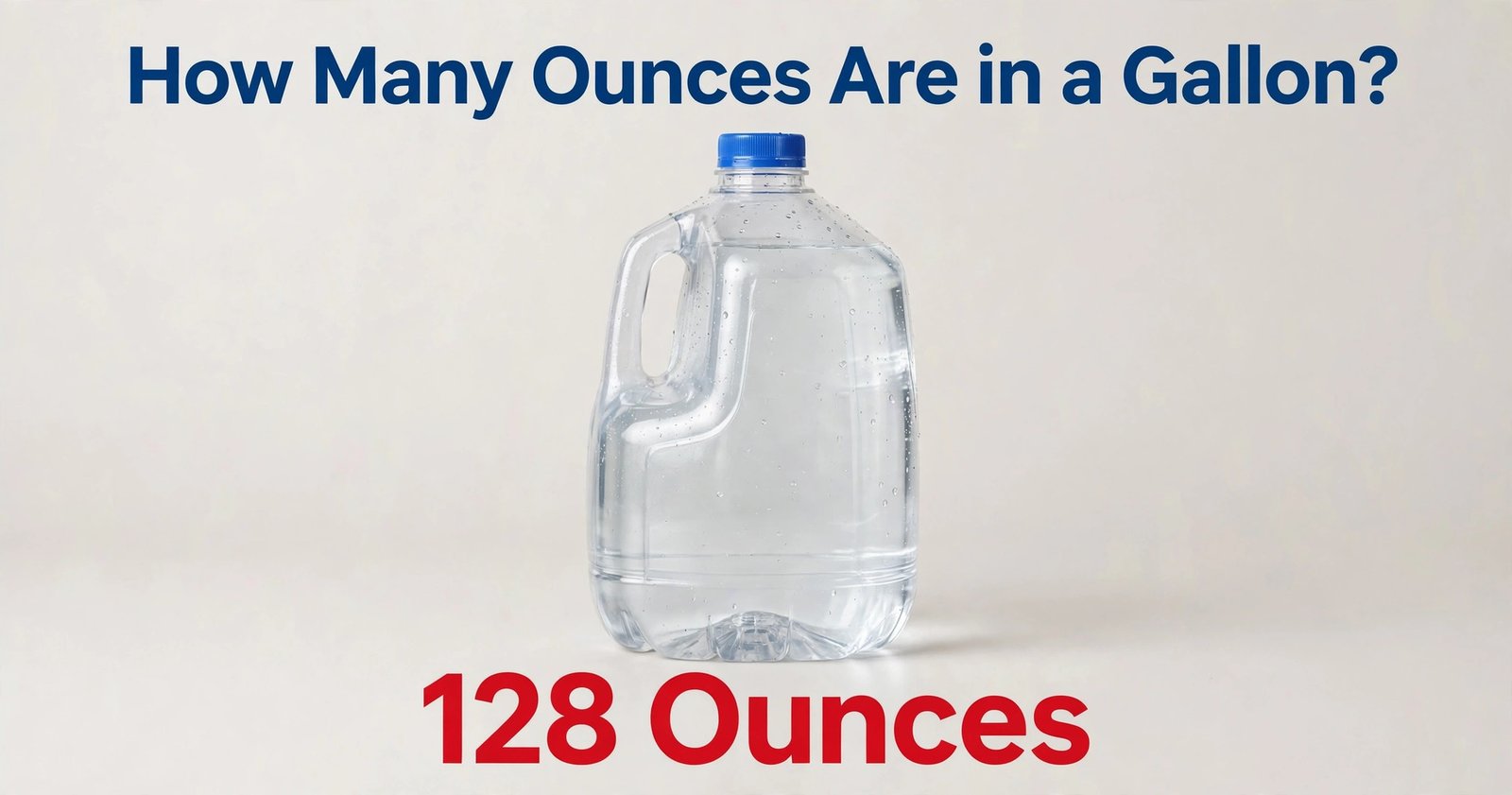
How many ounces are in a gallon? One US gallon holds 128 US fluid ounces. That is the number on milk jugs, water bottles and recipes across America. But there is a second answer you need to know: one imperial gallon, the gallon used in the United Kingdom, holds 160 imperial fluid ounces. The US gallon and the UK gallon are not the same size, so the number of ounces in a gallon depends on which gallon you mean.
That difference trips up a lot of people. A US gallon is smaller than an imperial gallon — 1 US gallon equals 3.78541 litres, while 1 imperial gallon equals 4.54609 litres — so the imperial gallon holds 32 more fluid ounces. Use 128 for a British recipe and your answer will be wrong by a quarter of a gallon. This guide gives you both numbers, clearly labelled, with the formulas and worked examples.
| Unit | US gallon | UK (imperial) gallon |
|---|---|---|
| Fluid ounces in 1 gallon | 128 US fl oz | 160 imperial fl oz |
| Litres in 1 gallon | 3.78541 L | 4.54609 L |
| Millilitres in 1 gallon | 3,785.41 ml | 4,546.09 ml |
| Quarts in 1 gallon | 4 US quarts (32 US fl oz each) | 4 imperial quarts (40 imperial fl oz each) |
| Pints in 1 gallon | 8 US pints (16 US fl oz each) | 8 imperial pints (20 imperial fl oz each) |
| Cups in 1 gallon | 16 US cups (8 US fl oz each) | No imperial cup in the system |
| 1 fluid ounce in millilitres | 29.5735 ml | 28.4131 ml |
| Fluid ounces in 1 litre | 33.814 US fl oz | 35.195 imperial fl oz |
Quick tip: Multiply US gallons by 128 to get US fluid ounces, and multiply UK (imperial) gallons by 160 to get imperial fluid ounces — never mix the two numbers.
The US Gallon Explained: 128 Fluid Ounces
The US gallon is the gallon used in the United States, and it holds 128 US fluid ounces. One US gallon equals 4 US quarts of 32 US fluid ounces each — 4 times 32 is 128. It also equals 8 pints of 16 fl oz and 16 cups of 8 fl oz. The numbers form a simple halving ladder: 128, 64, 32, 16, 8.
In metric terms, 1 US gallon equals 3.78541 litres, or 3,785.41 millilitres — the exact conversion used in science, engineering and trade. The US fluid ounce is defined precisely too: 1 US fluid ounce equals 29.5735 millilitres, and 128 times 29.5735 is 3,785.41.
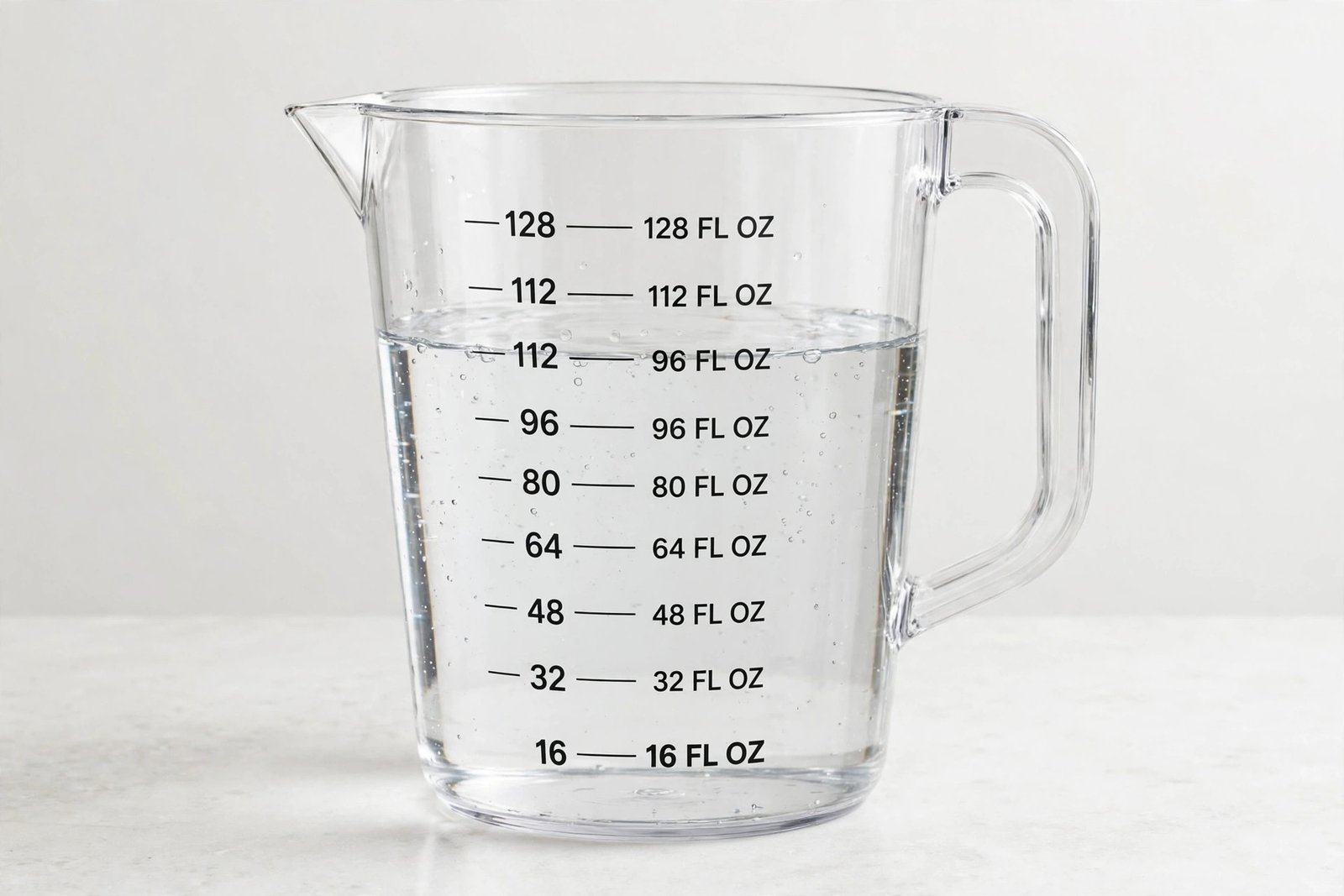
The US gallon is the standard gallon for milk, juice, water, petrol and paint in the United States, so an American label saying “1 gallon” means 128 US fluid ounces. A half-gallon jug of milk holds 64 US fluid ounces — 2 US quarts or 4 US pints.
The UK (Imperial) Gallon Explained: 160 Fluid Ounces
The imperial gallon, the gallon used in the United Kingdom, holds 160 imperial fluid ounces. That is 32 fluid ounces more than the US gallon, making the imperial gallon about 20 percent larger. One imperial gallon equals 4 imperial quarts of 40 fl oz each and 8 imperial pints of 20 fl oz each.
In metric terms, 1 imperial gallon equals 4.54609 litres, or 4,546.09 millilitres. The imperial fluid ounce is also slightly different: 1 imperial fluid ounce equals 28.4131 millilitres, a little less than the US fluid ounce at 29.5735 millilitres. The two systems must never be mixed.
The imperial gallon is still the legal gallon in the UK. It survives in miles per gallon: the same car shows a higher figure in the UK, because 1 imperial gallon equals about 1.20095 US gallons — 30 miles per US gallon is about 36 miles per imperial gallon. The imperial pint is also still used in Britain: a pint of milk or beer is 20 imperial fluid ounces, not the 16 US fluid ounces of an American pint.
US vs UK Gallon — Why They Differ
The US gallon and the imperial gallon differ because they were defined from different things, hundreds of years apart, and neither country changed to match the other. The imperial gallon was defined in Britain in 1824 as the volume of 10 pounds of water at a set temperature, producing a gallon of 4.54609 litres and 160 imperial fluid ounces. The US gallon descends from the old English wine gallon of 231 cubic inches — 3.78541 litres and 128 US fluid ounces.
The gap is 32 fluid ounces — the imperial gallon holds a quarter of a US gallon more, or 0.76068 litres. The conversion between the two gallons is simple: 1 imperial gallon equals 1.20095 US gallons, and 1 US gallon equals 0.832674 imperial gallons.
The difference shows up most sharply in fuel economy: a car rated at 40 miles per imperial gallon in the UK is doing about 33.3 miles per US gallon. The same trap waits in recipes: a gallon of stock means 160 imperial fluid ounces in Britain but 128 US fluid ounces in America. Label the gallon every time and check the source country before you convert.
The Formulas: Gallons to Ounces and Ounces to Gallons
Converting needs one formula in each direction, in two versions — US and imperial. To convert gallons to fluid ounces, multiply by the fluid ounces in one gallon. For US gallons: fluid ounces = gallons × 128. For imperial gallons: fluid ounces = gallons × 160.
To convert fluid ounces back to gallons, divide instead. For US fluid ounces: gallons = fluid ounces ÷ 128. For imperial fluid ounces: gallons = fluid ounces ÷ 160. Between systems, go through litres: US gallons × 3.78541, imperial gallons × 4.54609. The most useful everyday conversions, in plain list form, are:
- 1 US gallon = 128 US fluid ounces = 3.78541 litres
- 1 imperial gallon = 160 imperial fluid ounces = 4.54609 litres
- 1 US quart = 32 US fluid ounces = 0.946353 litres
- 1 US pint = 16 US fluid ounces = 473.176 millilitres
- 1 US cup = 8 US fluid ounces = 236.588 millilitres
- 1 imperial pint = 20 imperial fluid ounces = 568.262 millilitres
- 1 litre = 33.814 US fluid ounces = 35.195 imperial fluid ounces
- 1 US fluid ounce = 29.5735 millilitres; 1 imperial fluid ounce = 28.4131 millilitres
The US cup has no imperial equivalent. And 1 litre equals 33.814 US fluid ounces but 35.195 imperial fluid ounces.
Worked Examples: Gallons to Ounces, Step by Step
Here are the conversions people actually look up. Half a US gallon is 0.5 × 128 = 64 US fluid ounces — the half-gallon milk jug. Two US gallons is 2 × 128 = 256 US fluid ounces; five is 5 × 128 = 640. Going the other way, 64 US fluid ounces is 64 ÷ 128 = 0.5 US gallons.
Now the imperial examples, using 160. One imperial gallon is 160 imperial fluid ounces, by definition. Two imperial gallons is 2 × 160 = 320 imperial fluid ounces; five is 5 × 160 = 800; half is 0.5 × 160 = 80, or 4 imperial pints. Going the other way, 80 imperial fluid ounces is 80 ÷ 160 = 0.5 imperial gallons.
Litres cross between the two systems. One litre equals 33.814 US fluid ounces, and the same litre equals 35.195 imperial fluid ounces. So a 2-litre bottle holds 67.628 US fluid ounces and 70.39 imperial fluid ounces. A 500-millilitre bottle holds 16.907 US fluid ounces, just over 1 US pint. And a standard 16.9-fluid-ounce water bottle means about 7.6 of them fill a US gallon.
Fluid Ounces vs Weight Ounces: Not the Same Ounce
The word “ounce” names two different units. A fluid ounce measures volume — how much space a liquid takes up. A weight ounce measures mass — how heavy something is. A US fluid ounce of water weighs about 1.043 weight ounces. That is close to one-to-one, which is why people mix them up — but for anything denser or lighter than water the gap grows.
A US gallon of water weighs about 8.34 pounds: 128 × 1.043 = 133.53 weight ounces, or 8.345 pounds. An imperial gallon of water weighs about 10.02 pounds (160 × 1.0022 = 160.35 weight ounces). Those weights are true for water only: milk about 8.6 pounds a gallon, honey about 12, cooking oil about 7.7.
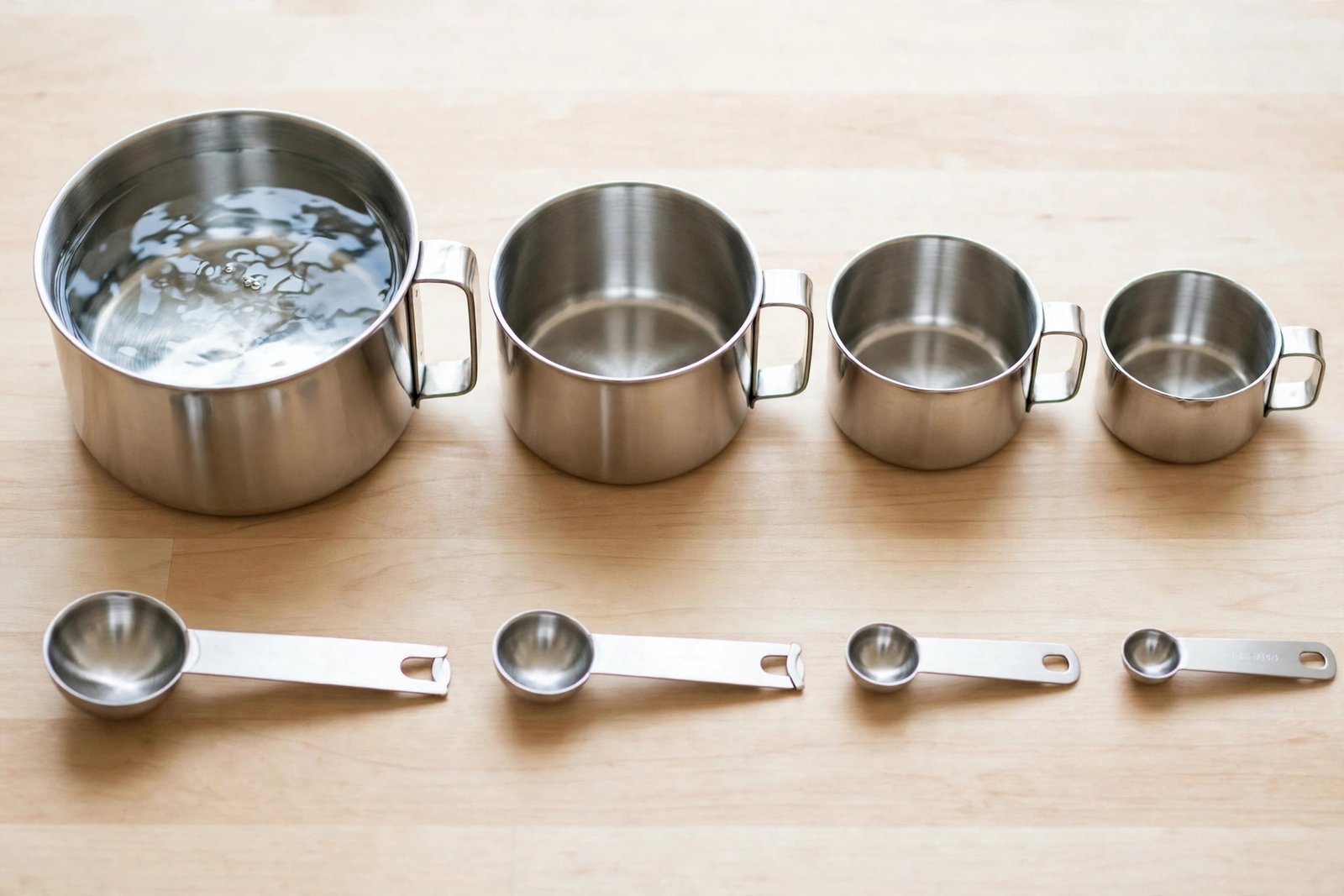
This is why “8 ounces of flour” and “8 fluid ounces of milk” mean different things: the milk is one US cup by volume, while 8 weight ounces of flour fills about one and a half to two US cups. Kitchen scales measure weight ounces; measuring jugs and cups measure fluid ounces. Use a scale for dry ingredients, a jug for liquids, and check for “fl oz” on the label.
Everyday Uses: Where Gallons and Ounces Meet
The 128-ounce US gallon is the one Americans meet every day. The most familiar is the milk jug: a US gallon jug holds 128 US fluid ounces, a half-gallon jug holds 64, a quart holds 32 and a pint holds 16. The same sizes carry juice, water and cooking oil too.
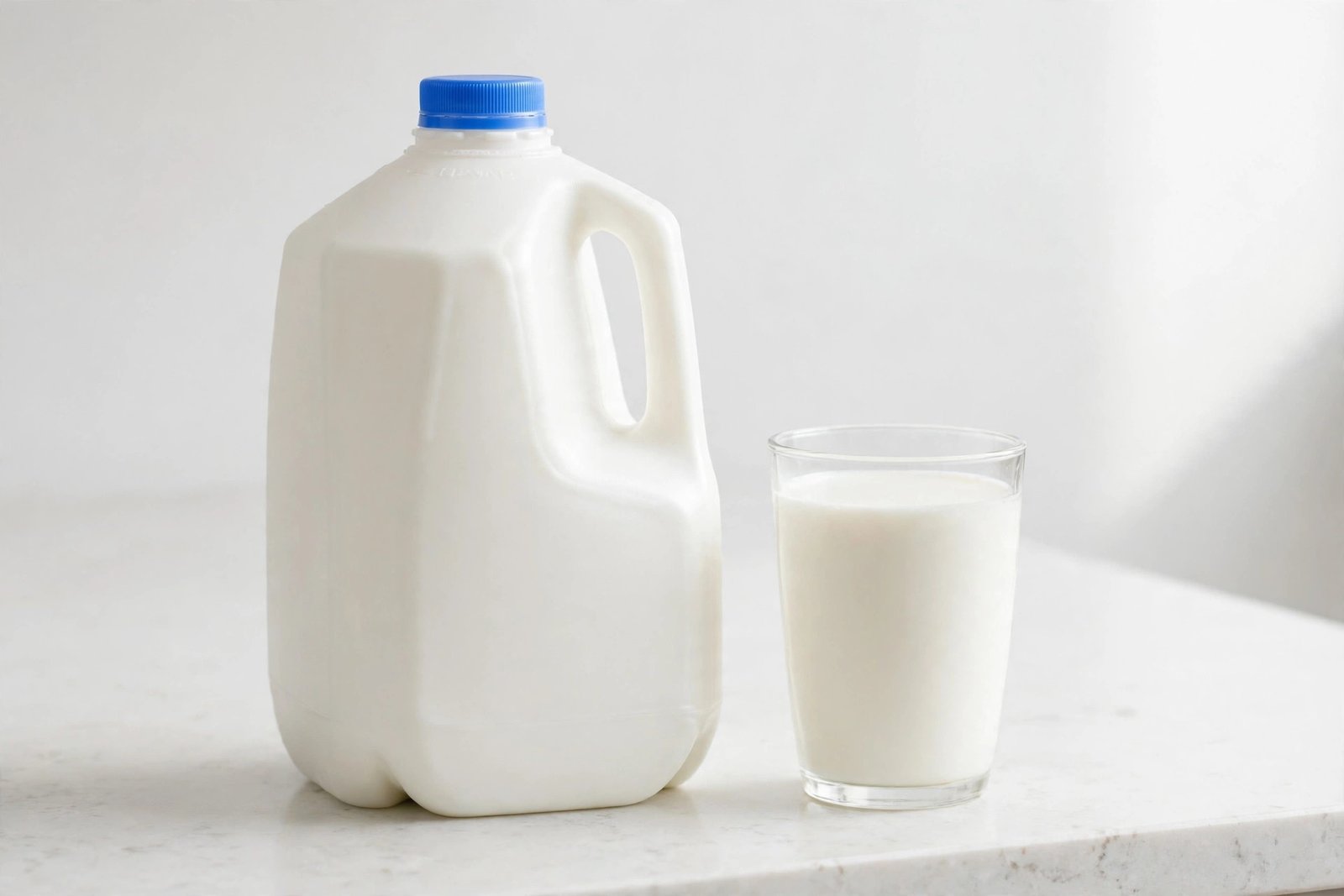
Fuel is the second: petrol in the US is sold by the US gallon, so a 12-gallon tank holds 1,536 US fluid ounces. In the UK, petrol is sold by the litre at the pump, but fuel economy is still quoted in miles per imperial gallon — which is why British and American figures for the same car never match. A third everyday use is drinking water: advice often suggests around 64 US fluid ounces a day — exactly half a US gallon. Paint and car coolant are sold by the gallon too. In the UK, the everyday gallon survives in the pint — 20 imperial fluid ounces of milk or beer — and in miles per imperial gallon, even though most liquids are now sold by the litre.
Common Mistakes to Avoid
The mistakes people make with gallons and ounces are few, but they change the answer by a lot. The first and biggest is using 128 for a UK gallon: every gallon comes out 32 fluid ounces short, a 25 percent error — a 5-gallon British tank is 800 imperial fluid ounces, not 640. The second mistake is the mirror image — using 160 for a US gallon, which leaves you a quarter of a gallon too much liquid.
Third, mixing fluid ounces and weight ounces: volume and mass only match approximately for water. Fourth, confusing US and imperial pints and quarts: a US pint is 16 US fl oz, an imperial pint 20; a US quart is 32 US fl oz, an imperial quart 40. Fifth, forgetting that the fluid ounce itself differs: 1 US fluid ounce is 29.5735 millilitres while 1 imperial fluid ounce is 28.4131 millilitres. Sixth, rounding too early: keep 3.78541 and 4.54609 until the last step and round only the final answer.
FAQ Section
How many ounces are in a gallon?
One US gallon holds 128 US fluid ounces; one imperial (UK) gallon holds 160. In the US the answer is 128, in the UK it is 160 — always check which gallon is meant.
How many ounces are in a half gallon?
Half a US gallon holds 64 US fluid ounces; half an imperial gallon holds 80 imperial fluid ounces.
How many fluid ounces are in a gallon of water?
A US gallon of water holds 128 US fluid ounces and weighs about 8.34 pounds; an imperial gallon holds 160 imperial fluid ounces and weighs about 10.02 pounds.
How many cups are in a gallon?
One US gallon holds 16 US cups (8 US fl oz each; 16 × 8 = 128). The imperial system has no cup, so the question only has a US answer.
Is a UK gallon bigger than a US gallon?
Yes — 4.54609 litres against 3.78541 litres, about 20 percent larger. One imperial gallon equals 1.20095 US gallons; one US gallon equals 0.832674 imperial gallons.
How many ounces are in a litre?
One litre holds 33.814 US fluid ounces and 35.195 imperial fluid ounces — the US fluid ounce (29.5735 ml) is slightly larger than the imperial one (28.4131 ml).
Conclusion
So, how many ounces are in a gallon? In the United States, the answer is 128 US fluid ounces — 4 US quarts, 8 US pints or 16 US cups, and 3.78541 litres. In the United Kingdom, the answer is 160 imperial fluid ounces — 4 imperial quarts or 8 imperial pints, and 4.54609 litres. Label the system every time — US or imperial, fluid or weight ounces — and never use one system’s number in the other’s formula. Remember the two formulas: US fluid ounces equal gallons times 128, and imperial fluid ounces equal gallons times 160. Next time someone asks how many ounces are in a gallon, ask them which gallon — and then give them the right number with confidence.
Related Guides
- How Many Miles Are in a Kilometer? 0.621 Miles, Formula & Easy Chart
- How Many Meters Are in a Kilometer? 1,000 Meters Explained Simply
- How Long Is a Kilometer? Distance in Miles, Feet & Meters Explained
- How Much Is a Kilometer? Distance, Walking Time & Conversions
- 13 Common Things That Are 2 Feet Long (With Pictures)