How many meters are in a kilometer? There are exactly 1,000 meters in a kilometer. One kilometer (1 km) equals 1,000 meters (1,000 m) — no rounding, no exceptions. It is one of the cleanest conversions in the metric system, and once you know it, every kilometer-to-meter question becomes a single multiplication.
The meter is the base unit of length, and the kilometer is the same unit made 1,000 times bigger by the prefix “kilo.” You meet kilometers every day: road signs, running apps, map scale bars, and races — the 5K, the 10K, the marathon — are all measured in kilometers. This guide covers why the answer is 1,000, the conversion rule, worked examples, other units, and everyday examples.
How Many Meters Are in a Kilometer — Conversion Chart
1 Kilometer Conversion Chart
| Unit | Equivalent to 1 kilometer |
|---|---|
| Meters | 1,000 m |
| Centimeters | 100,000 cm |
| Millimeters | 1,000,000 mm |
| Feet | 3,280.84 ft |
| Yards | 1,093.61 yd |
| Miles | 0.621371 mi |
Quick tip: Multiply kilometers by 1,000 to get meters — 1 kilometer is exactly 1,000 meters.
What Does “Kilo” Mean?
The word “kilometer” has two parts: “kilo” and “meter.” “Meter” is the base unit of length, and “kilo” is a prefix from the Greek khilioi, meaning “a thousand.” So a kilometer is, literally, a thousand meters — the name itself contains the answer.
The same prefix “kilo” always means 1,000: a kilogram is 1,000 grams, a kiloliter is 1,000 liters, and a kilowatt is 1,000 watts.
The metric system is built on powers of ten: 10 millimeters make a centimeter, 100 centimeters make a meter, and 1,000 meters make a kilometer — the kilometer is exactly 1,000 times longer than a meter, and that never changes.
The Simple Rule: Multiply by 1,000
The rule is the shortest in measurement: multiply the number of kilometers by 1,000. That is the whole method — no second step, no extra constant, no rounding, because the conversion is exact by definition.
- Meters = kilometers × 1,000
- Kilometers = meters ÷ 1,000
The second formula is the reverse: to go from meters to kilometers, divide by 1,000. Either way you use the same number, 1,000 — only multiply or divide changes.

In action: 2 km is 2 × 1,000 = 2,000 meters, 0.5 km is 0.5 × 1,000 = 500 meters, and 7 km is 7 × 1,000 = 7,000 meters. The pattern never changes: add three zeros, or move the decimal point three places right. Going the other way, 3,000 m is 3,000 ÷ 1,000 = 3 kilometers.
The decimal-point trick is the fastest way to do it in your head: multiplying by 1,000 shifts the point three places right (4.25 km becomes 4,250 m), and dividing shifts it three places left (4,250 m becomes 4.25 km). If there is no decimal point, imagine one at the end — 6 km is 6.000 km, so shifting right gives 6,000 m.
How to Convert Kilometers to Meters, Step by Step
Four short steps, in order, give the right answer every time.
Step 1: Write down the kilometers. To convert 2.5 kilometers, write down 2.5 km.
Step 2: Multiply by 1,000. 2.5 × 1,000 = 2,500.
Step 3: Write the answer in meters. 2.5 kilometers equals 2,500 meters — always write the unit with the number.
Step 4: Check your answer. Meters should always outnumber kilometers, since a meter is much smaller. If your meter answer is smaller than the number you started with, you divided by mistake.
Second example: 0.75 km × 1,000 = 750 meters — the decimal point moved three places right. To go the other way, divide by 1,000: 1,800 meters ÷ 1,000 = 1.8 kilometers. With practice the steps become automatic: see kilometers, multiply by 1,000; see meters, divide by 1,000.
Worked Examples: Kilometers to Meters
Here are the conversions you are most likely to meet, from a short walk to a full marathon.
| Kilometers | Meters |
|---|---|
| 0.1 km | 100 m |
| 0.25 km | 250 m |
| 0.5 km | 500 m |
| 1 km | 1,000 m |
| 1.5 km | 1,500 m |
| 2 km | 2,000 m |
| 3 km | 3,000 m |
| 5 km | 5,000 m |
| 7.5 km | 7,500 m |
| 10 km | 10,000 m |
| 42.195 km (marathon) | 42,195 m |
| 100 km | 100,000 m |
A few are worth noting in words: half a kilometer is 0.5 × 1,000 = 500 meters — about a five-minute walk — and a marathon is officially 42.195 kilometers, or 42.195 × 1,000 = 42,195 meters. A half marathon is 21.0975 kilometers, or 21,097.5 meters, and a 100-kilometer ultramarathon is 100,000 meters. The rule never changes — always multiply by 1,000.
Converting Meters Back to Kilometers
Converting meters to kilometers is the reverse: divide the number of meters by 1,000.
250 meters is 250 ÷ 1,000 = 0.25 kilometers, 750 meters is 750 ÷ 1,000 = 0.75 kilometers, 1,500 meters is 1,500 ÷ 1,000 = 1.5 kilometers, and 5,000 meters is 5,000 ÷ 1,000 = 5 kilometers. Each answer is the meter value with three zeros removed, or the decimal point moved three places left.
The decimal-point trick works here too: move the point three places left. 2,750 meters becomes 2.75 kilometers, and 800 meters becomes 0.8 kilometers. A common use is reading a running watch: 6,400 meters is 6,400 ÷ 1,000 = 6.4 kilometers. Remember the direction: kilometers to meters, multiply, because meters are smaller and you need more of them; meters to kilometers, divide, because kilometers are bigger and you need fewer.
How Many Centimeters, Millimeters, Feet, Yards and Miles Are in a Kilometer?
A kilometer is not only 1,000 meters. It can be expressed exactly in smaller metric units, and approximately in the imperial units used in the United States.
In centimeters, a kilometer is 100,000 centimeters: 1,000 meters × 100 centimeters per meter = 100,000. In millimeters, it is 1,000,000 millimeters: 1,000 × 1,000 = 1,000,000. One million millimeters in a kilometer shows how small a millimeter is — about the thickness of a credit card.
In feet, a kilometer is 3,280.84 feet: one foot is exactly 0.3048 meters, so 1,000 ÷ 0.3048 = 3,280.839895 feet, rounding to 3,280.84. In yards, it is 1,093.61 yards: one yard is 0.9144 meters, so 1,000 ÷ 0.9144 = 1,093.613298 yards, rounding to 1,093.61.
In miles, a kilometer is 0.621371 miles — the figure travelers meet most often, since US road distances are posted in miles. One mile is 1.609344 kilometers, so one kilometer is 1 ÷ 1.609344 = 0.621371 miles. A mile is 1.609 kilometers, or 1,609.344 meters — noticeably longer than a kilometer.
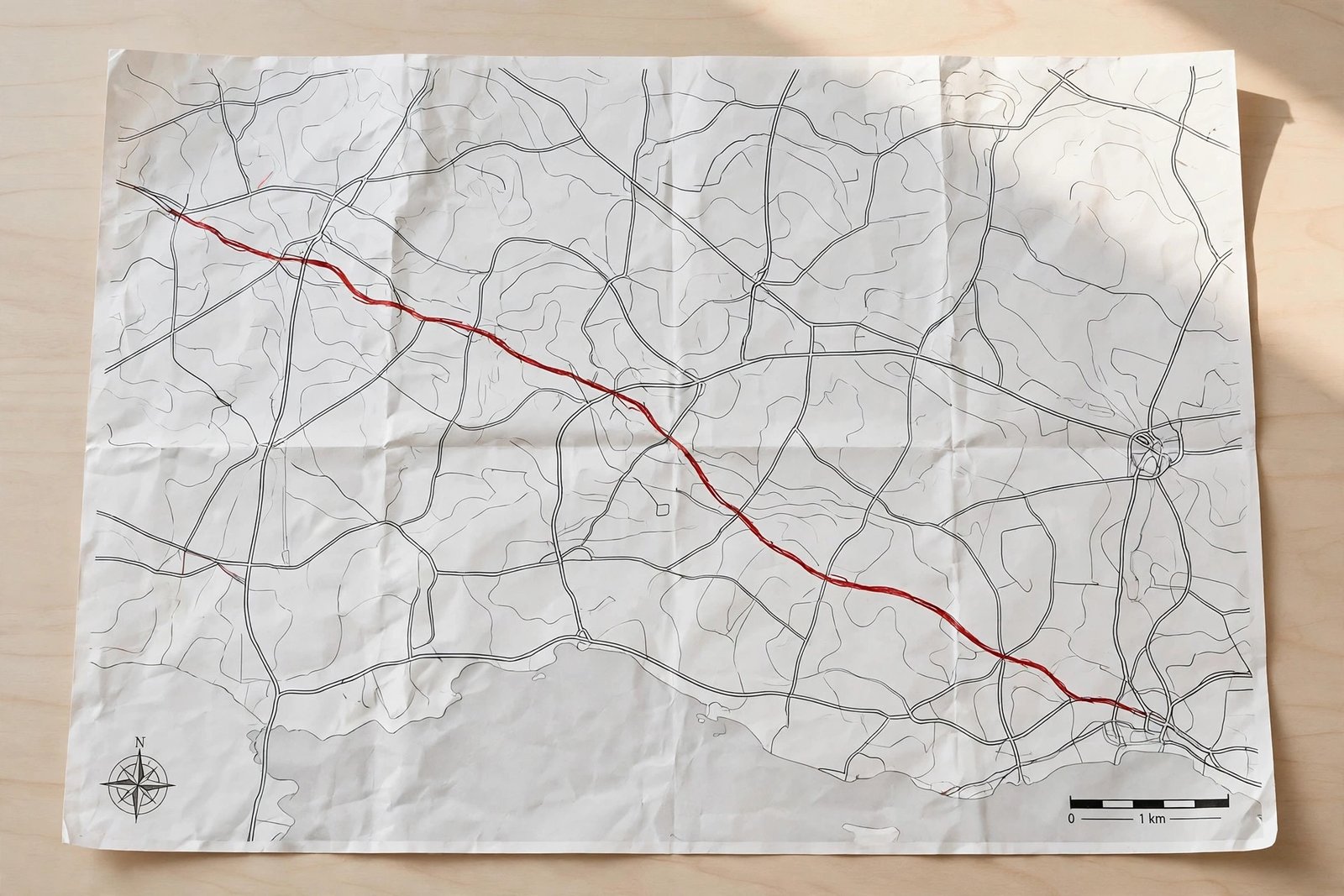
These values matter when reading a map or planning a trip: when a GPS says 2 kilometers away, that is 2,000 meters, about 6,562 feet, or about 1.24 miles. For everyday use, rounded figures are enough — about 0.62 miles, 3,281 feet, 1,094 yards — but when precision matters, use the full figures: 3,280.84 feet, 1,093.61 yards and 0.621371 miles. In the metric system there is never any rounding: 1,000 meters, 100,000 centimeters and 1,000,000 millimeters are exact.
A Kilometer in Everyday Life
A kilometer is an everyday distance. The easiest way to feel how long it is comes from places you already know: a running track, a race, a walk, and road signs.
The running track is the best picture of a kilometer. A standard track is 400 meters around one lap, so two and a half laps are 2.5 × 400 = 1,000 meters — exactly one kilometer. If you have ever walked a school track, you have a built-in kilometer measure: two laps and a half.

Race names tell you the distance: a 5K is 5 kilometers, or 5 × 1,000 = 5,000 meters; a 10K is 10 kilometers, or 10,000 meters; a marathon is 42.195 kilometers, or 42,195 meters; and a half marathon is 21.0975 kilometers, or 21,097.5 meters.
Walking gives another feel for a kilometer. An average adult walks about 5 kilometers per hour, so one kilometer takes about 12 minutes. A 12-minute walk to school or the shops is very likely close to one kilometer. In steps, a kilometer is roughly 1,250 to 1,550 steps — about 1,300 is a good rule of thumb.
Road signs are where most people see kilometers written down. On highways in metric countries, signs tell you how many kilometers remain to the next town. When a sign says 1 kilometer, the town is 1,000 meters ahead — about a 12-minute walk or a one-minute drive.
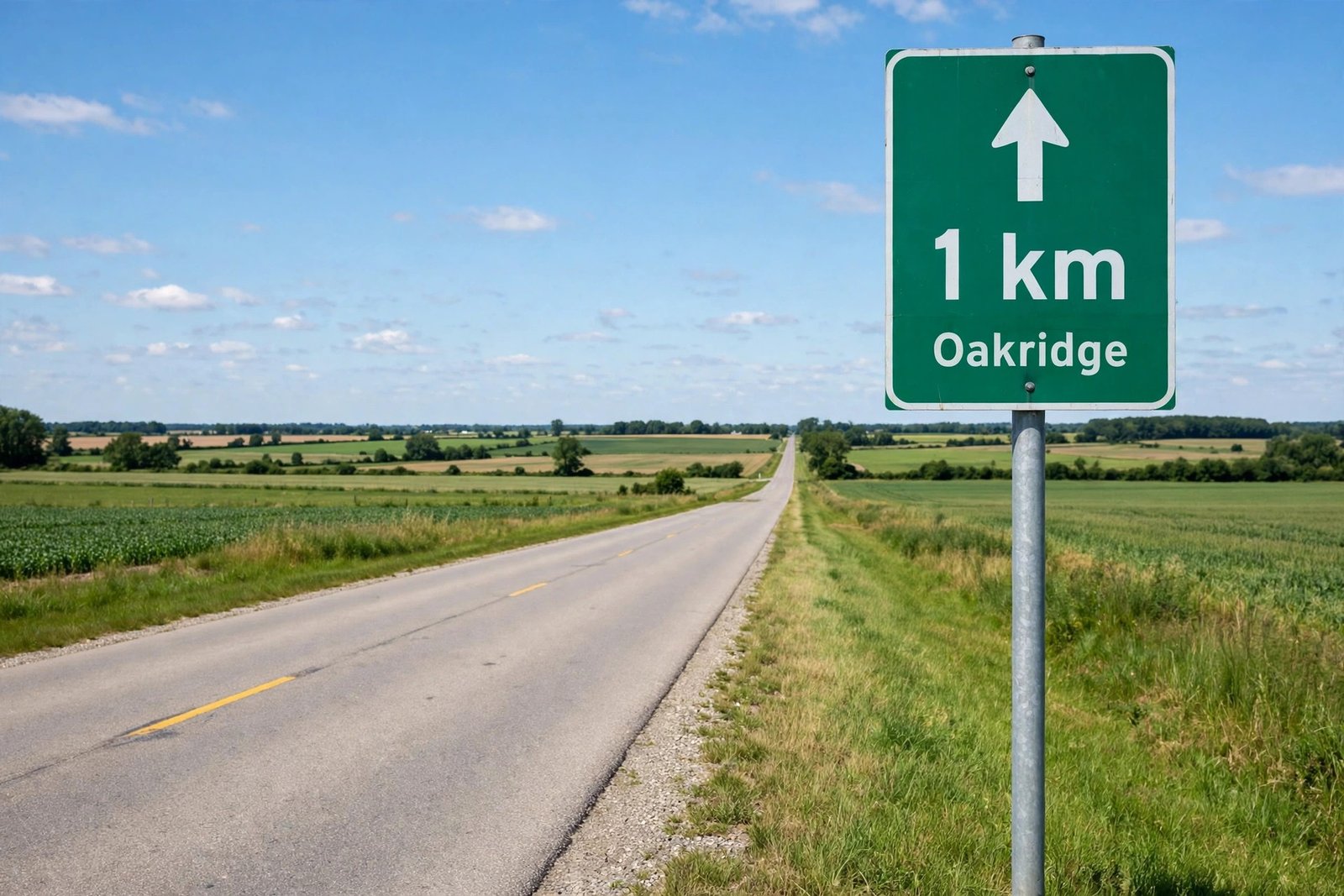
In many grid-planned cities, about 10 to 12 short blocks add up to roughly one kilometer, and a kilometer is close to 10 American football fields end to end — a field is 91.44 meters long, so 1,000 ÷ 91.44 is about 10.9 fields. However you picture it, a kilometer is a short, human-scale journey, always exactly 1,000 meters.
Common Mistakes When Converting Kilometers and Meters
The conversion is simple, but a few mistakes show up again and again. Knowing them in advance is the best way to avoid them.
Adding the wrong number of zeros. Multiplying by 100 instead of 1,000 gives an answer ten times too small. One kilometer is not 100 meters — it is 1,000 meters. Remember: centi means 100, kilo means 1,000.
Confusing meters and centimeters. One kilometer is not 1,000 centimeters — it is 100,000. The chain has two steps: kilometers to meters (× 1,000), then meters to centimeters (× 100). Likewise, one kilometer is 1,000,000 millimeters, not 1,000.
Forgetting to divide when going from meters to kilometers. Meters to kilometers means dividing by 1,000, so the answer must be smaller. Multiplying out of habit gives absurd answers: 5,000 meters is 5 kilometers, not 5,000,000.
Mixing up kilometers and miles. One kilometer is 0.621371 miles, and one mile is 1.609344 kilometers. A 5K race is 3.1 miles, not 5 miles, and a 10-kilometer drive is about 6.2 miles, not 10.
Dropping the decimal in race distances. A marathon is 42.195 kilometers and a half marathon is 21.0975. Rounding before converting loses 195 meters and 97.5 meters. Convert the full number: 42.195 × 1,000 = 42,195 meters, and 21.0975 × 1,000 = 21,097.5 meters.
Forgetting the unit in the answer. A bare “2,500” means nothing — 2,500 meters and 2,500 kilometers are wildly different. Always write the unit with the number.
FAQ Section
How many meters are in a kilometer?
There are exactly 1,000 meters in a kilometer. One kilometer (1 km) equals 1,000 meters (1,000 m). The conversion is exact by definition, because the prefix “kilo” means 1,000.
How many meters are in 2 kilometers?
There are 2,000 meters in 2 kilometers. Multiply the number of kilometers by 1,000: 2 × 1,000 = 2,000 meters. The same rule gives 3,000 meters in 3 kilometers and 5,000 meters in 5 kilometers.
How many kilometers is 5,000 meters?
5,000 meters is 5 kilometers. Divide the number of meters by 1,000: 5,000 ÷ 1,000 = 5 kilometers. Similarly, 1,500 meters is 1.5 kilometers and 250 meters is 0.25 kilometers.
Is a kilometer longer than a mile?
No, a kilometer is shorter than a mile. One kilometer equals 0.621371 miles, while one mile equals 1.609344 kilometers. A 5-kilometer race is about 3.1 miles, not 5 miles.
How many centimeters are in a kilometer?
There are 100,000 centimeters in a kilometer. One kilometer is 1,000 meters, and each meter is 100 centimeters, so 1,000 × 100 = 100,000 centimeters. A kilometer is also 1,000,000 millimeters.
How do you convert meters to kilometers?
Divide the number of meters by 1,000. For example, 750 meters ÷ 1,000 = 0.75 kilometers, and 10,000 meters ÷ 1,000 = 10 kilometers. Moving the decimal point three places to the left does the same thing.
Conclusion
So, how many meters are in a kilometer? The answer is 1,000 meters — exactly, every time, with no rounding and no exceptions. The word itself tells you: “kilo” means 1,000, and a kilometer is 1,000 meters laid end to end.
The rule to remember is just as simple. To turn kilometers into meters, multiply by 1,000: 2 kilometers is 2,000 meters, 5 kilometers is 5,000 meters, and a marathon’s 42.195 kilometers is 42,195 meters. To turn meters into kilometers, divide by 1,000: 500 meters is 0.5 kilometers, 1,500 meters is 1.5 kilometers, and 5,000 meters is 5 kilometers. In the other units, one kilometer is 100,000 centimeters, 1,000,000 millimeters, 3,280.84 feet, 1,093.61 yards, and 0.621371 miles.
The best way to keep the answer in your head is to picture it. Two and a half laps of a 400-meter running track is one kilometer. A 5K race is 5,000 meters. A 12-minute walk covers about one kilometer. A road sign that says 1 kilometer is pointing to a place 1,000 meters away. Once you have that picture, the number follows on its own: one kilometer, one thousand meters.
Related Guides
- How Many Miles Are in a Kilometer? 0.621 Miles, Formula & Easy Chart
- How Long Is a Kilometer? Distance in Miles, Feet & Meters Explained
- How Much Is a Kilometer? Distance, Walking Time & Conversions
- How Many Ounces Are in a Gallon? 128 Ounces Explained (US & UK)
- 13 Common Things That Are 2 Feet Long (With Pictures)