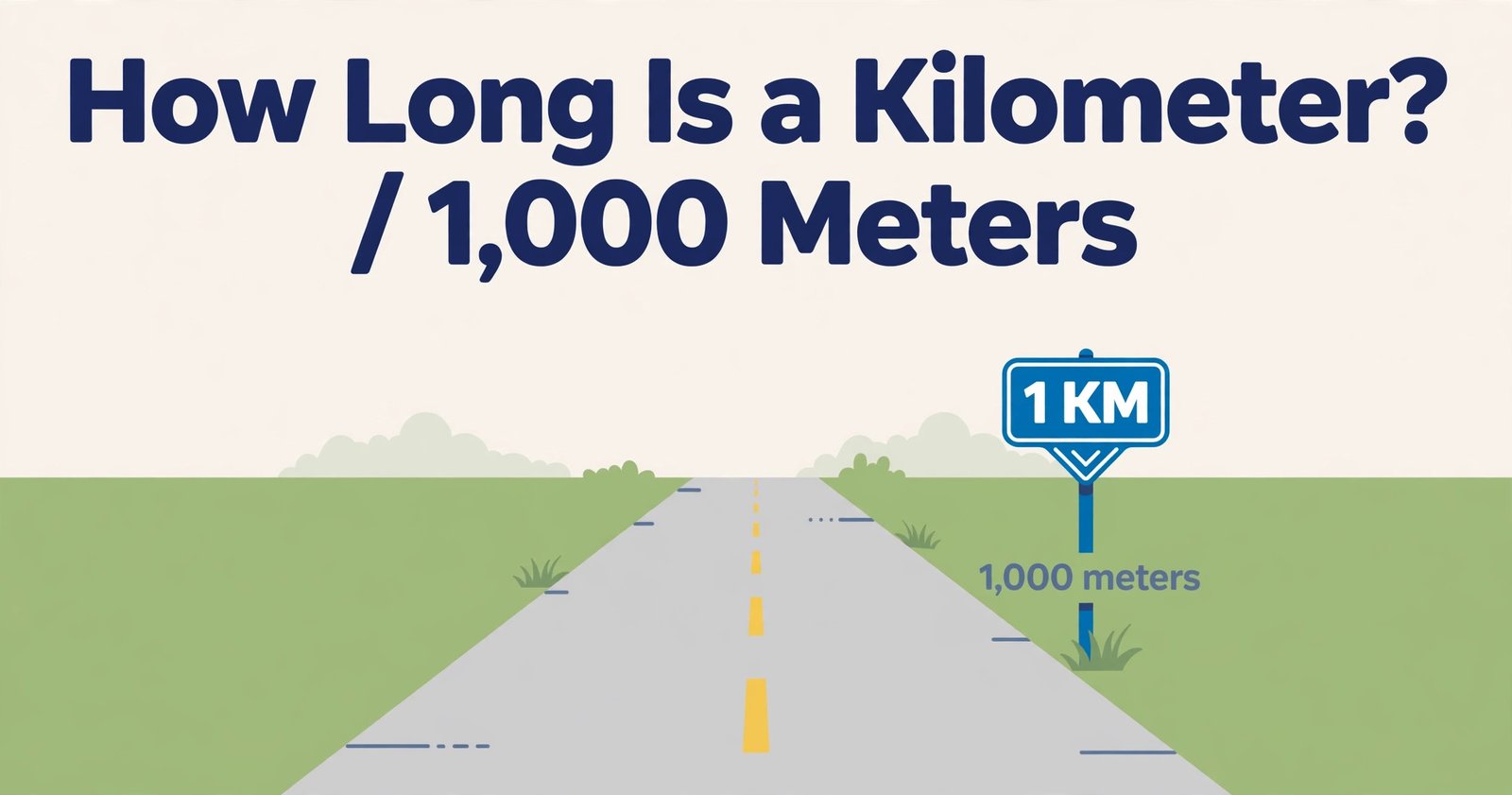
How long is a kilometer? A kilometer is 1,000 meters long. That is 0.621371 miles, or 3,280.84 feet. If you walk at a steady, brisk pace, it takes about 12 minutes to cover one kilometer, and if you drive at 60 kilometers per hour, it takes about 1 minute.
A kilometer is the everyday distance unit of most of the world. Road signs in Europe, Canada, Australia, and almost every other country outside the United States measure distance in kilometers, and races are run over 5 and 10 kilometers. Yet if you grew up thinking in miles and feet, a kilometer can feel hard to picture. Is it longer than a mile, or shorter? How far is it in steps, in minutes, and in streets you already know?
This guide answers that in full: a kilometer converted into every common unit, how long it takes to walk, run, cycle, and drive it, and how to picture it with a running track, football fields, and city blocks. By the end, a kilometer will be a distance you can feel and use with confidence, whether you are planning a walk, reading a race result, or working out how far away a place really is.
| Unit | Equivalent to 1 kilometer |
|---|---|
| Meters | 1,000 m |
| Kilometers | 1 km |
| Miles | 0.621371 mi |
| Feet | 3,280.84 ft |
| Yards | 1,093.61 yd |
| Centimeters | 100,000 cm |
| Millimeters | 1,000,000 mm |
Quick tip: Multiply kilometers by 0.621371 to get miles — 1 kilometer is 0.621371 miles.
A Kilometer in Every Unit
A kilometer is 1,000 meters. The prefix “kilo” means one thousand, so the word itself tells you the answer. To turn kilometers into meters, multiply by 1,000; to turn meters into kilometers, divide by 1,000. A 5-kilometer run is 5,000 meters, and a 500-meter walk is half a kilometer. In miles, a kilometer is shorter than a mile: one kilometer is 0.621371 miles, just under five-eighths of a mile, while one mile is 1.609344 kilometers, about 61 percent longer. A town 10 kilometers away is 6.21371 miles away, a 5-kilometer race is 3.10686 miles, and 3 kilometers on a fitness tracker is 1.86411 miles.
In feet, one kilometer is 3,280.84 feet, a little over 62 percent of a mile’s 5,280 feet. It helps to break it down: 100 meters is 328.08 feet, so ten 100-meter stretches make a kilometer. In yards, one kilometer is 1,093.61 yards, since 0.621371 times 1,760 yards in a mile is 1,093.61. In smaller metric units the numbers get large but stay simple: one kilometer is 100,000 centimeters and 1,000,000 millimeters, exact figures because the metric system is built on powers of ten. Two quick rules cover almost every everyday conversion: multiply kilometers by 0.621371 (roughly 0.62) to get miles, and multiply miles by 1.609344 (roughly 1.6) to get kilometers. Remember too that 5 kilometers is very close to 3 miles (3.10686).
How Long Does It Take to Walk a Kilometer?
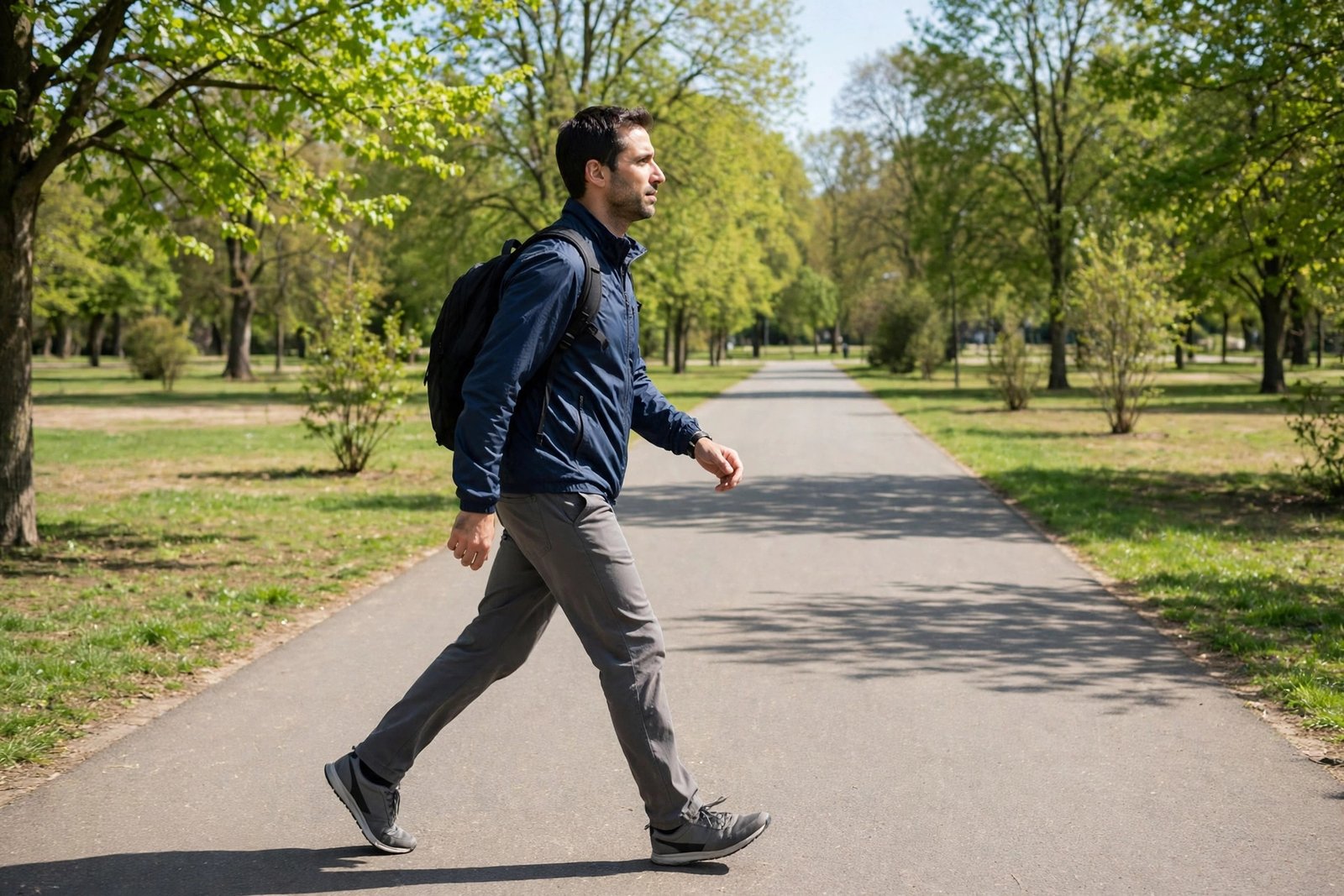
At a brisk walking speed of 5 kilometers per hour, one kilometer takes about 12 minutes, because 60 divided by 5 is 12. At a relaxed pace of 4 kilometers per hour, it takes about 15 minutes, and at a fast walk of 6 kilometers per hour, about 10 minutes. So about 12 to 15 minutes per kilometer is the right planning figure.
Your own time varies with the ground, the weather, and what you carry. Uphill walking slows you down, and a steep hill can add several minutes to a kilometer. Flat, smooth pavement is faster than sand, gravel, or a muddy path, and a heavy bag, a stroller, or small children slow most people down. Steps are another way to measure it: an average adult step is about 0.76 meters, so it takes about 1,300 steps to walk one kilometer.
How Long Does It Take to Run a Kilometer?
A fit adult runner covers one kilometer in about 5 to 6 minutes, a speed of 10 to 12 kilometers per hour. At 10 kilometers per hour the time is 6 minutes per kilometer, and at 12 it is 5 minutes. Jogging is slower: a comfortable jog at 8 kilometers per hour works out at about 7.5 minutes per kilometer, and a gentle jog at 6 to 7 kilometers per hour takes about 8 to 10 minutes per kilometer. If you are starting out and your first kilometer takes about 8 to 10 minutes, that is completely normal; speed comes with weeks of regular running, and forcing a 5-minute kilometer too soon is a quick way to get injured.
The surface and the slope matter for running just as they do for walking, only more so. A flat running track is the fastest place to run a kilometer, with a smooth surface, no hills, and no traffic. A hilly road can add a minute or more per kilometer, and a hot day slows almost everyone down. Compare times on the same route at the same time of day, so the only thing changing is your fitness. The meaningful milestones are simpler: breaking 8 minutes per kilometer, then 7, then 6, and then holding that pace for 5 kilometers without stopping.
How Long Does It Take to Drive or Cycle a Kilometer?

In a car, a kilometer passes very quickly. At 60 kilometers per hour, one kilometer takes about 1 minute. At 30 kilometers per hour, a common town speed limit, it takes about 2 minutes. At 100 kilometers per hour, a typical highway speed, it takes about 36 seconds, since 60 divided by 100 is 0.6 minutes. In practice, though, a car rarely holds one steady speed: traffic lights and junctions mean a kilometer in a busy city can easily take 3 to 5 minutes.
Cycling sits between walking and driving. A relaxed cyclist at 15 kilometers per hour covers one kilometer in about 4 minutes, and a fitter cyclist at 20 kilometers per hour in about 3 minutes, so about 3 to 4 minutes per kilometer is the right planning figure. A steep climb can cut a cyclist to 8 or 10 kilometers per hour, or about 6 to 7.5 minutes per kilometer. When a map says a place is one kilometer away, read it three ways at once: about 12 to 15 minutes on foot, about 3 to 4 minutes by bicycle, and about 1 to 2 minutes by car.
Picturing a Kilometer in the Real World

Numbers alone rarely make a distance feel real; what works is tying it to places you have already seen. The best is the running track. A standard outdoor running track is 400 meters around its inside lane, so one kilometer is about 2.5 laps. Run two full laps and you have covered 800 meters; run one more half lap and you have the full 1,000 meters. American football fields give another clear picture: the distance between the goal lines is 100 yards, or 91.44 meters, so one kilometer is about 11 of those fields laid end to end.
City streets are the most everyday picture of all. A kilometer is about 10 to 12 city blocks, depending on the city. In many grid cities a block is about 80 to 100 meters long, so ten to twelve blocks add up to roughly 1,000 meters. In Manhattan, the short blocks are about 80 meters, so about 12 of them make a kilometer. That is a reminder that a city block is not a fixed unit.

A kilometer is also about 1,300 walking steps. None of these pictures is exact on its own. The next time you see a sign that says a place is one kilometer away, picture two and a half laps of a track, or ten city blocks, or about 1,300 steps, and the distance will click into place.
Worked Examples: 2 Kilometers, 5 Kilometers and 10 Kilometers
The best way to lock in a kilometer is to work with the distances you actually meet: 2, 5, and 10 kilometers, the distances on road signs, race bibs, and fitness apps.
- 2 kilometers is 2,000 meters, 1.24274 miles, and 6,561.68 feet. Walking it takes about 24 minutes at 5 kilometers per hour and about 30 minutes at 4 kilometers per hour. Running it takes about 10 to 12 minutes for a fit runner and about 16 to 20 minutes jogging. Driving it at 60 kilometers per hour takes about 2 minutes, and cycling it takes about 6 to 8 minutes.
- 5 kilometers is 5,000 meters, 3.10686 miles, and 16,404.20 feet. Walking it takes about 60 minutes at 5 kilometers per hour and about 75 minutes at 4 kilometers per hour. Running it takes about 25 to 30 minutes for a fit runner. Jogging it takes about 40 to 50 minutes, driving it about 5 minutes, and cycling it about 15 to 20 minutes. Five kilometers is also 12.5 laps of a 400-meter track.
- 10 kilometers is 10,000 meters, 6.21371 miles, and 32,808.40 feet. Walking it takes about 120 minutes at 5 kilometers per hour and about 150 minutes at 4 kilometers per hour. Running it takes about 50 to 60 minutes for a fit runner. Jogging it takes about 80 to 100 minutes, driving it about 10 minutes at 60 kilometers per hour, and cycling it about 30 to 40 minutes. Ten kilometers is 25 laps of a 400-meter track.
Common Mistakes When Thinking About a Kilometer
The most common mistake is thinking a kilometer is the same as a mile. It is not: a mile is 1.609344 kilometers, about 61 percent longer. If you treat them as equal, you will underestimate every distance in kilometers by more than a third. A 10-kilometer race is 6.21371 miles, not 10 miles, and a speed limit of 100 kilometers per hour is 62.1371 miles per hour, not 100. The fix is simple: multiply kilometers by 0.62 to get miles, and miles by 1.61 to get kilometers.
A second mistake is mixing up kilometers and miles on road signs when traveling. In the United States, a sign that says 50 means 50 miles. In most of Europe, Canada, and Australia, a sign that says 50 means 50 kilometers, which is only 31.0686 miles. Always check which unit the sign uses.
A third mistake is confusing kilometers with meters. One kilometer is 1,000 meters, so a run of 5,000 meters is 5 kilometers, not 5,000 kilometers, and a walk of 500 meters is half a kilometer. Dropping or adding three zeros turns a short walk into an impossible journey. Finally, do not assume walking, running, and driving times scale the same way: a kilometer takes about 12 minutes on foot and about 1 minute in a car, so attach a speed to every estimate and it will stay honest.
FAQ Section
How long is a kilometer in miles?
One kilometer is 0.621371 miles, just under five-eighths of a mile. Multiply kilometers by 0.621371 to get miles, and miles by 1.609344 to get kilometers.
How long is a kilometer in feet?
One kilometer is 3,280.84 feet, or 1,093.61 yards. A mile is 5,280 feet, so a kilometer is about 62 percent of a mile in feet.
How long does it take to walk a kilometer?
About 12 minutes at a brisk 5 kilometers per hour, and about 15 minutes at a relaxed 4 kilometers per hour. Most adults walk at 4 to 5 kilometers per hour, so about 12 to 15 minutes per kilometer is the right planning figure.
How long does it take to run a kilometer?
A fit runner covers one kilometer in about 5 to 6 minutes (10 to 12 kilometers per hour). Jogging takes about 8 to 10 minutes per kilometer (6 to 7.5 kilometers per hour). A 5-kilometer run at 5 to 6 minutes per kilometer takes about 25 to 30 minutes in total.
Is a kilometer longer than a mile?
No. A kilometer is shorter than a mile. One mile is 1.609344 kilometers, about 61 percent longer than a kilometer, and one kilometer is 0.621371 miles.
How many laps of a running track is a kilometer?
About 2.5 laps of a standard 400-meter running track. Two full laps are 800 meters, and one more half lap brings the total to 1,000 meters. Five kilometers is 12.5 laps, and 10 kilometers is 25 laps.
Conclusion
So, how long is a kilometer? A kilometer is 1,000 meters, which is 0.621371 miles, 3,280.84 feet, 1,093.61 yards, and 100,000 centimeters. It takes about 12 minutes to walk at a brisk pace, about 5 to 6 minutes to run if you are fit, about 3 to 4 minutes to cycle, and about 1 minute to drive at 60 kilometers per hour. You can picture it as about 2.5 laps of a 400-meter running track, about 11 American football fields of 91.44 meters, about 10 to 12 city blocks, or about 1,300 walking steps.
Keep those figures in mind the next time a road sign, a race bib, or a fitness tracker gives you a distance in kilometers. Picture it with a running track or a row of city blocks. A kilometer is a thousand meters, a little over six-tenths of a mile, and a distance your own feet already know how to measure.
Related Guides
- How Many Miles Are in a Kilometer? 0.621 Miles, Formula & Easy Chart
- How Many Meters Are in a Kilometer? 1,000 Meters Explained Simply
- How Much Is a Kilometer? Distance, Walking Time & Conversions
- How Many Ounces Are in a Gallon? 128 Ounces Explained (US & UK)
- 13 Common Things That Are 2 Feet Long (With Pictures)






1 thought on “How Long Is a Kilometer? Distance in Miles, Feet & Meters Explained”