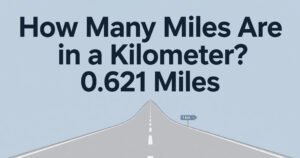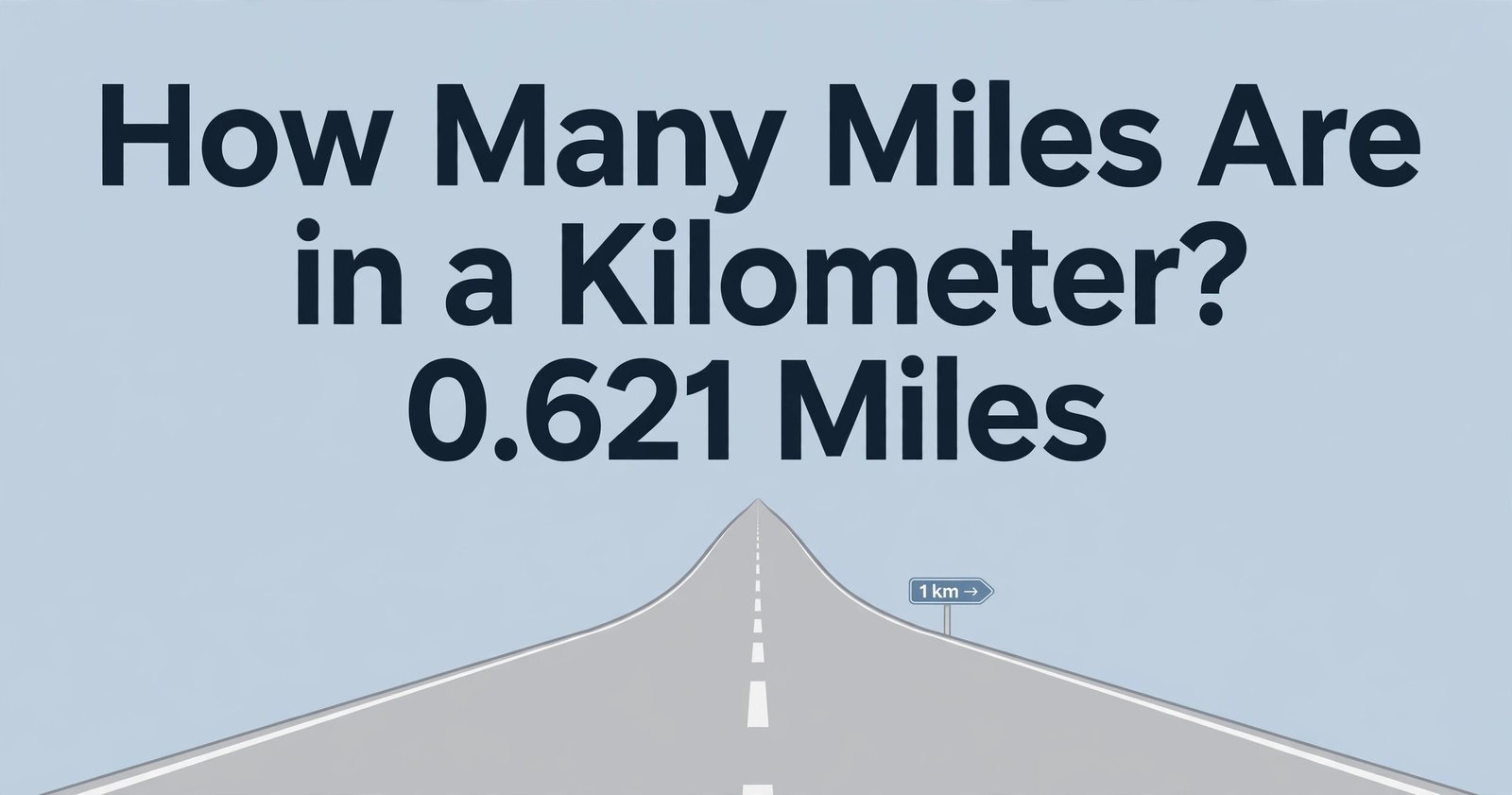
How many miles are in a kilometer? One kilometer is 0.621 miles — more precisely, 1 kilometer equals 0.621371 miles. So a kilometer is a little over six-tenths of a mile, and a mile is noticeably longer than a kilometer. If you drive 10 kilometers, you have driven 6.21371 miles.
The world is split between the two units. The United States measures road distances and speed limits in miles, while most other countries — including Canada, Mexico, and almost all of Europe — measure them in kilometers.
The conversion is simple: one number to remember, 0.621371, and one direction — multiply kilometers by it to get miles. This guide gives you the exact formula, a step-by-step method, worked examples from 1 kilometer to a full marathon, a plain table of the common values, the reverse conversion, and the everyday places where kilometers show up.
How Many Miles Are in a Kilometer — Conversion Chart
1 Kilometer Conversion Chart
| Kilometers | Miles |
|---|---|
| 1 km | 0.621371 mi |
| 2 km | 1.24274 mi |
| 3 km | 1.86411 mi |
| 5 km | 3.10686 mi |
| 10 km | 6.21371 mi |
| 21.0975 km (half marathon) | 13.1094 mi |
| 42.195 km (marathon) | 26.2188 mi |
Quick tip: Multiply kilometers by 0.621371 to get miles — 1 kilometer is 0.621371 miles.
The Formula: How to Convert Kilometers to Miles
The formula for converting kilometers to miles is short enough to memorize in seconds:
miles = kilometers × 0.621371
Take the number of kilometers, multiply it by 0.621371, and the answer is the distance in miles.
The reverse formula, for converting miles back to kilometers, is the mirror image:
kilometers = miles × 1.60934
Here you multiply miles by 1.60934 to get kilometers. The two factors are reciprocals: 1 divided by 0.621371 is 1.60934, and 1 divided by 1.60934 is 0.621371. That is why the formulas work in both directions, and why mixing them up is the most common mistake in this conversion.
For everyday use, the rounded factor 0.621 is fine for a quick estimate: 10 kilometers is about 6.21 miles. When precision matters, use the full 0.621371.
Remember the relationship in words too: a kilometer is about 62 percent of a mile, so any distance in kilometers is always a smaller number in miles. If your answer in miles comes out larger than the kilometers you started with, you used the wrong factor.
How to Convert Kilometers to Miles Step by Step
Converting kilometers to miles takes four small steps, and the same steps work for 1 kilometer or 1,000 kilometers.
Step 1: Write down the distance in kilometers. Start with the number you already have — from a road sign, a race entry, or a map. For this example, use 5 kilometers.
Step 2: Multiply by 0.621371. The calculation is 5 × 0.621371 = 3.106855. Round the answer to two decimal places for everyday distances, so 3.106855 becomes 3.11 miles.
Step 3: Label the answer in miles. This is the step people skip, and it is how a 3.11-mile run gets written down as 3.11 kilometers by mistake. Always write the unit with the number: 3.11 miles, not just 3.11.
Step 4: Check that the answer makes sense. Miles are longer than kilometers, so the number of miles must be smaller than the number of kilometers you started with.
Worked Examples: Kilometers to Miles
1 kilometer = 0.621371 miles. This is the base conversion: 1 × 0.621371 = 0.621371. One kilometer is a little over six-tenths of a mile — about a 12-minute walk at a steady pace.
2 kilometers = 1.24274 miles. The calculation is 2 × 0.621371 = 1.242742, rounded to 1.24274 miles — about one and a quarter miles.
3 kilometers = 1.86411 miles. The calculation is 3 × 0.621371 = 1.864113, rounded to 1.86411 miles — just under 1.9 miles.
5 kilometers = 3.10686 miles. The calculation is 5 × 0.621371 = 3.106855, rounded to 3.10686 miles. This is the 5K race distance, and it is the conversion runners ask about most. A 5K is not 5 miles — it is just over 3 miles.
10 kilometers = 6.21371 miles. The calculation is 10 × 0.621371 = 6.21371 miles. This is the 10K race distance — a little over 6 miles.
Half marathon: 21.0975 kilometers = 13.1094 miles. The calculation is 21.0975 × 0.621371 = 13.109375, rounded to 13.1094 miles — just over 13.1 miles.
Marathon: 42.195 kilometers = 26.2188 miles. The calculation is 42.195 × 0.621371 = 26.21875, rounded to 26.2188 miles — just over 26.2 miles, which is why marathons are described as 26.2 miles. Two longer distances are worth knowing as well: 50 kilometers = 31.06855 miles (usually 31.07 miles) and 100 kilometers = 62.1371 miles.
Common Kilometers to Miles Values
The plain table below lists the distances people look up most, from a single kilometer to 100 kilometers. All values use the full factor 0.621371.
| Kilometers | Miles |
|---|---|
| 1 km | 0.62137 mi |
| 2 km | 1.24274 mi |
| 3 km | 1.86411 mi |
| 4 km | 2.48548 mi |
| 5 km | 3.10686 mi |
| 6 km | 3.72823 mi |
| 7 km | 4.34960 mi |
| 8 km | 4.97097 mi |
| 9 km | 5.59234 mi |
| 10 km | 6.21371 mi |
| 15 km | 9.32057 mi |
| 20 km | 12.42742 mi |
| 25 km | 15.53428 mi |
| 30 km | 18.64113 mi |
| 40 km | 24.85484 mi |
| 50 km | 31.06855 mi |
| 60 km | 37.28226 mi |
| 80 km | 49.70968 mi |
| 100 km | 62.13710 mi |
A few rows are worth memorizing: 1 kilometer is 0.621 miles, 5 kilometers is 3.11 miles, and 10 kilometers is 6.21 miles. Eight kilometers is 4.97 miles, so close to 5 miles that it is used as a mental landmark: 8 kilometers is about 5 miles and 80 kilometers is about 50 miles. For drivers, 100 kilometers is 62.14 miles. One kilometer is also 1,000 meters, 3,280.84 feet, and 1,093.61 yards, and it is 2.5 laps of a standard 400-meter running track.
Converting Miles Back to Kilometers
Sometimes you need the conversion in the other direction. The formula is kilometers = miles × 1.60934. Use the same method, and check that the kilometers figure is larger than the miles you started with, because kilometers are shorter than miles.
1 mile = 1.60934 kilometers. The calculation is 1 × 1.60934 = 1.60934. One mile is about 1.61 kilometers — longer than a kilometer by more than 600 meters.
5 miles = 8.04672 kilometers. The calculation is 5 × 1.60934 = 8.0467, rounded to 8.04672 kilometers using the exact factor 1.609344. A 5-mile run is just over 8 kilometers.
10 miles = 16.0934 kilometers. The calculation is 10 × 1.60934 = 16.0934 kilometers. A 10-mile race is about 16.1 kilometers.
26.2 miles = 42.1647 kilometers. The calculation is 26.2 × 1.60934 = 42.16471, rounded to 42.1647 kilometers — very close to the official marathon distance of 42.195 kilometers, because 26.2 miles is itself a rounded figure.
Speed converts the same way. A speed of 100 kilometers per hour is 62.1371 miles per hour, usually written as 62.14 mph, and 50 kilometers per hour is 31.0686 miles per hour, or about 31 mph. Going the other way, 60 miles per hour is 96.5604 kilometers per hour, or about 97 km/h, and 30 miles per hour is 48.2802 kilometers per hour, or about 48 km/h.
Where You See Kilometers in Everyday Life
Road signs and driving
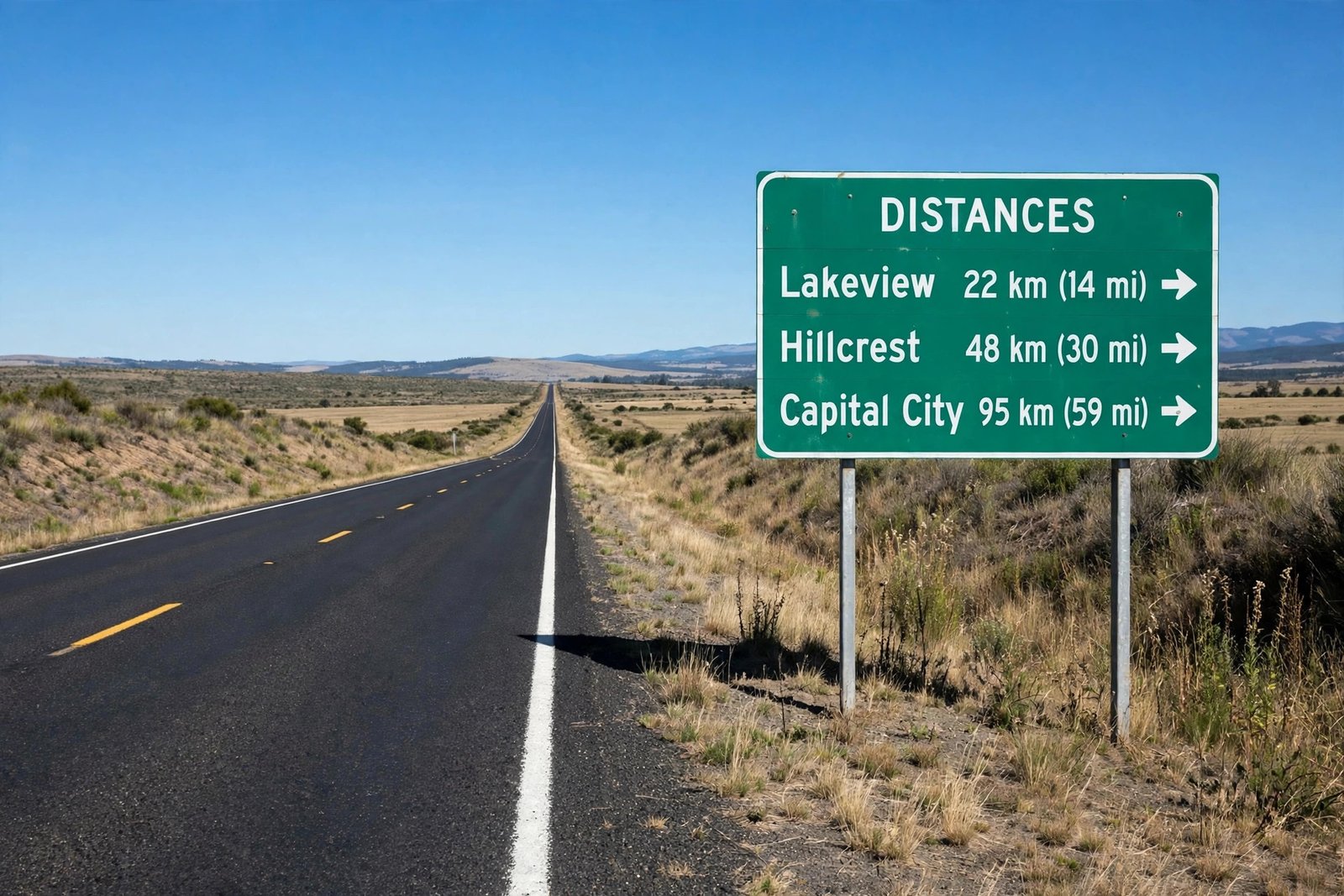
The most common place to meet kilometers is on the road. Outside the United States, road signs give distances in kilometers and speed limits in kilometers per hour. A sign that says the next city is 95 kilometers away means it is about 59 miles away (95 × 0.621371 = 59.03025 miles). A sign that says 22 kilometers means about 14 miles, and 48 kilometers means about 30 miles. The landmarks to learn are 50 kilometers is about 31 miles, 100 kilometers is about 62 miles, and 150 kilometers is about 93 miles.
Running races: 5K, 10K, half marathon, and marathon
Running is the second place kilometers are unavoidable, because races around the world are measured in kilometers. A 5K is 5 kilometers, or 3.10686 miles. A 10K is 10 kilometers, or 6.21371 miles. A half marathon is 21.0975 kilometers, or 13.1094 miles. A marathon is 42.195 kilometers, or 26.2188 miles. Runners in the United States often train in miles and race in kilometers: a training run of 3 miles is about 4.83 kilometers (3 × 1.60934 = 4.82802 kilometers), and a race pace of 6 minutes per kilometer is about 9 minutes and 39 seconds per mile.

Car speedometers and walking
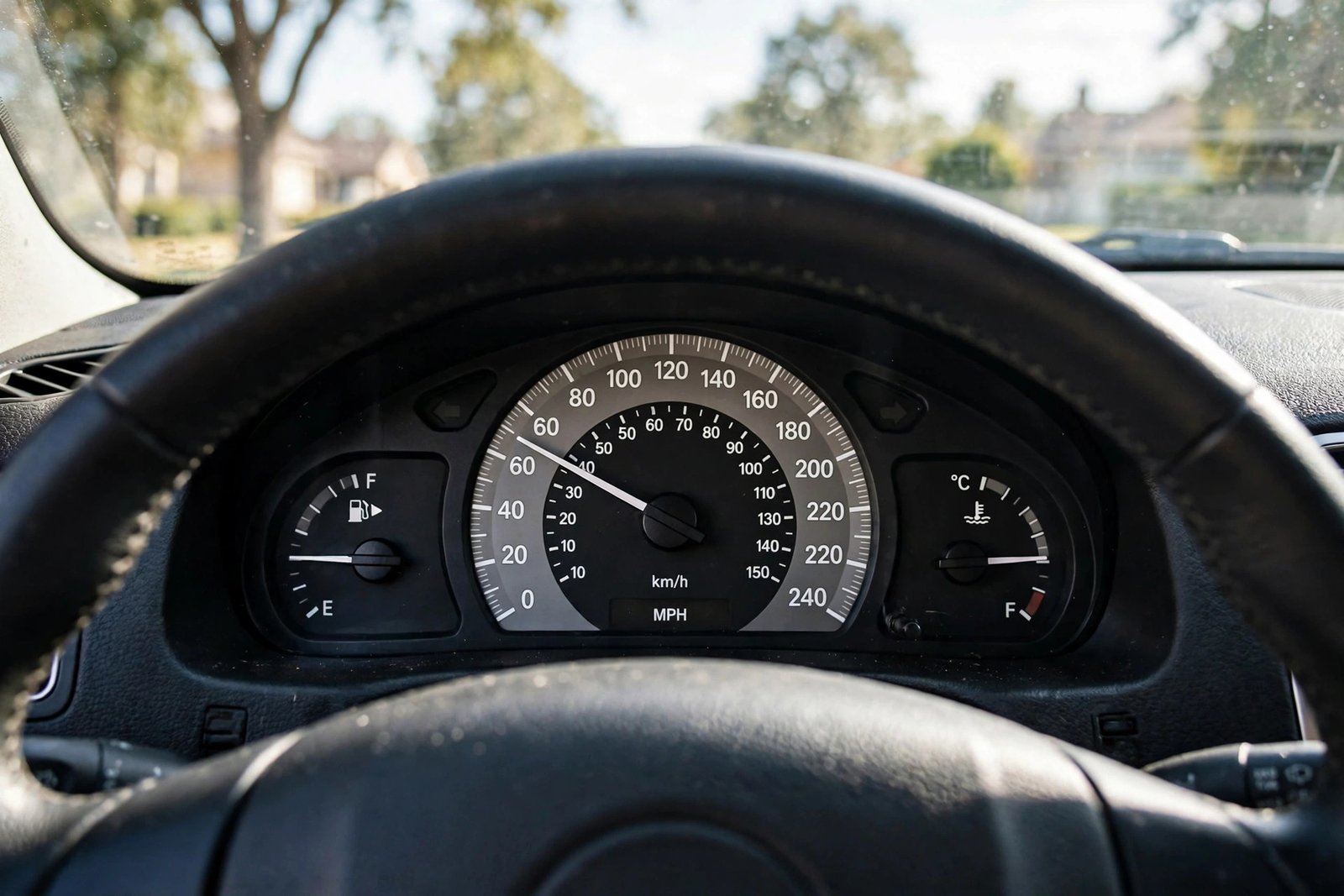
The third place kilometers show up is on the dashboard. Most cars sold outside the United States have a speedometer marked in kilometers per hour, and many cars sold in the United States show both scales. If your speedometer reads 100 km/h, you are doing about 62 mph, and if it reads 120 km/h, you are doing about 75 mph.
Walking is the quietest place kilometers appear. A comfortable walking speed is about 5 kilometers per hour, or about 3.11 miles per hour, so one kilometer takes about 12 minutes to walk.
Common Mistakes When Converting Kilometers to Miles
Using 0.62 and rounding too early. The rounded factor 0.62 is fine for a quick estimate, but over 100 kilometers it gives 62 miles instead of 62.1371 miles — an error of about 0.14 miles, or about 720 feet. Keep the full factor 0.621371 through the multiplication, and round only the final answer.
Using the wrong factor. This is the biggest mistake. If you multiply 10 kilometers by 1.60934 instead of 0.621371, you get 16.09 miles — which is the answer to a different question, namely how many kilometers are in 10 miles. The miles answer must be smaller than the kilometers you started with.
Confusing miles and kilometers on speed limits. A speed limit of 100 means very different things in the two systems: 100 kilometers per hour is about 62 miles per hour, while 100 miles per hour is about 161 kilometers per hour. Treating a 100 km/h limit as 100 mph would mean driving about 61 percent too fast.
Forgetting that a kilometer is 1,000 meters, not 100. This mistake usually shows up in race training, where someone treats a kilometer as 100 meters and plans a workout ten times too short.
Rounding the marathon and half marathon to whole miles. A marathon is often called 26 miles, but rounding 26.2188 miles to 26 drops about 0.22 miles, or about 350 meters. A half marathon is 13.1094 miles, so rounding to 13 miles drops about 0.11 miles, or about 176 meters. For casual conversation, 26.2 and 13.1 are the right figures to use.
FAQ Section
How many miles are in a kilometer?
One kilometer is 0.621371 miles, usually rounded to 0.621 miles. So a kilometer is a little over six-tenths of a mile, and a mile is longer than a kilometer.
How many miles are in 5 kilometers?
Five kilometers is 3.10686 miles, usually rounded to 3.11 miles. The calculation is 5 × 0.621371 = 3.106855. This is the 5K race distance.
How many miles are in 10 kilometers?
Ten kilometers is 6.21371 miles, usually rounded to 6.21 miles. The calculation is 10 × 0.621371 = 6.21371. This is the 10K race distance.
How do you convert kilometers to miles?
Multiply the number of kilometers by 0.621371. The formula is miles = kilometers × 0.621371. For example, 10 kilometers × 0.621371 = 6.21371 miles. To convert miles back to kilometers, multiply miles by 1.60934 instead.
How many kilometers are in a mile?
One mile is 1.60934 kilometers, usually rounded to 1.61 kilometers. So a mile is about 1.6 times as long as a kilometer, and a kilometer is about 62 percent of a mile.
Is a kilometer longer than a mile?
No — a mile is longer than a kilometer. One mile is 1.60934 kilometers, and one kilometer is 0.621371 miles. It takes about 1.61 kilometers to make one mile.
Conclusion
So, how many miles are in a kilometer? The answer is 0.621 miles — more precisely, 0.621371 miles. The formula is miles = kilometers × 0.621371, and the reverse is kilometers = miles × 1.60934. With those two numbers, you can convert any distance: 5 kilometers is 3.10686 miles, 10 kilometers is 6.21371 miles, a half marathon is 13.1094 miles, and a marathon is 26.2188 miles.
The pattern to carry away is simple: miles are longer than kilometers, so the number in miles is always smaller — about 62 percent of the number in kilometers. Check every conversion against that pattern, round only at the end, and use the full factor 0.621371 when precision matters.
Related Guides
- How Many Meters Are in a Kilometer? 1,000 Meters Explained Simply
- How Long Is a Kilometer? Distance in Miles, Feet & Meters Explained
- How Much Is a Kilometer? Distance, Walking Time & Conversions
- How Many Ounces Are in a Gallon? 128 Ounces Explained (US & UK)
- 13 Common Things That Are 2 Feet Long (With Pictures)